Simplifying Lease Asset Capitalization and Contingencies Under PSAK 73 & PSAK 116
Tuesday, July 21, 2026
How Indonesian Enterprises Can Eliminate Spreadsheet Risks and Automate Financial Compliance with Leasee
By Sazanka Henig Solusi
Modern lease accounting under PSAK 73 and PSAK 116 requires enterprises to move beyond fragmented spreadsheets and adopt automated financial platforms like Leasee to handle complex calculations, such as asset capitalization and end-of-lease contingencies, with precision and speed. The adoption of International Financial Reporting Standards (IFRS 16) into Indonesian accounting standards has fundamentally transformed how lessees record property, plant, and equipment leases by eliminating the divide between operating and finance leases. Organizations must now recognize virtually all lease contracts on the balance sheet by recording a Right-of-Use (ROU) Asset and a corresponding Lease Liability. Recent amendments under PSAK 116 further refine these guidelines, specifically synchronizing numbering standards and detailing the subsequent measurement of lease liabilities in sale and leaseback transactions.
To maintain compliance and protect financial transparency, accounting teams must master two critical accounting components that directly impact ROU asset valuation and monthly depreciation: Capitalization and Contingencies.
Mastering Capitalized and Contingency Lease Costs
Under PSAK 73 and PSAK 116, the initial valuation of a leased asset is not simply the sum of monthly rent payments. It must incorporate specific direct expenditures and probable future obligations incurred by the lessee:
Asset Capitalization: Initial direct costs incurred by the lessee to prepare an asset for its intended operating condition—such as architectural designs, site preparation, professional testing, or structural renovations—must be capitalized directly into the initial measurement of the ROU asset rather than expensed immediately. Capitalizing these expenses increases the asset's recorded value on the balance sheet and results in a higher monthly depreciation charge over the lease term.
Contingency Management: Contingencies represent uncertain future conditions that create an asset or obligation depending on future events. In lease agreements, contractual requirements to restore or recondition a property to its original standard at the end of the lease term (e.g., returning a modified commercial building or vehicle to standard condition) fall into this category. When these restoration obligations meet the criteria of being probable (likely to occur) and can be reliably estimated, they must be recognized as a liability provision and added to the initial ROU asset valuation.
Real-World Case Study: Food Truck Lease Accounting
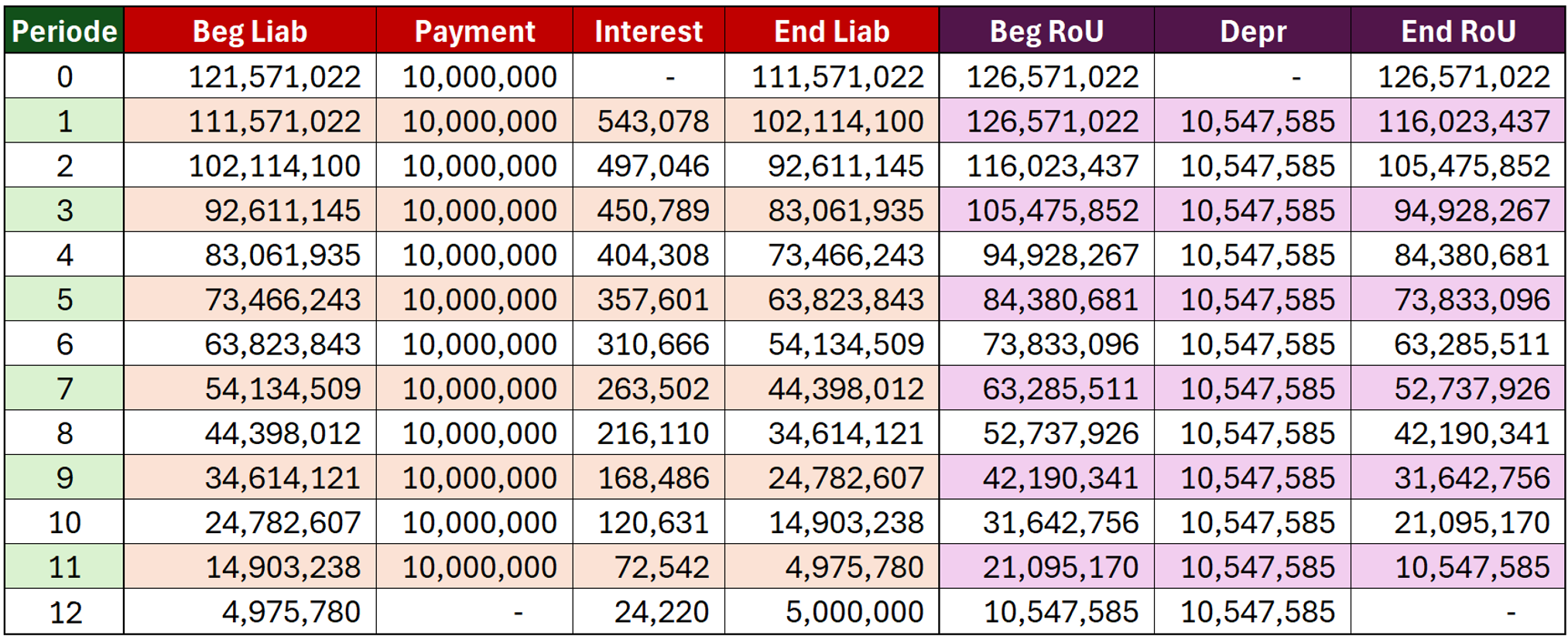
To see how capitalization and contingencies operate in practice, consider a company (Lessee A) that leases a Food Truck from a lessor (Lessor B) for a 12-month period at a fixed rental rate of Rp 10,000,000 per month, payable at the start of each month. The implicit annual interest rate is 6% (or 0.487% per month).
The Capitalized Cost: The lessee spends Rp 5,000,000 upfront to modify and renovate the truck into a specialized martabak food stall. Because this renovation is necessary to bring the asset to its intended operating condition, the Rp 5,000,000 is capitalized into the ROU asset.
The Contingency Cost: The lease contract stipulates that the lessee must return the food truck to its standard factory condition at the end of the 12-month lease, which is reliably estimated to cost Rp 5,000,000 in restoration expenses. The present value (PV) of this future obligation is recognized immediately as both a liability and an addition to the ROU asset.
Initial Present Value (PV) Valuations
Using the 0.487% monthly discount rate, the finance team calculates the foundational accounting values:
PV of Lease Payments: Rp 116,288,003
PV of Contingency (Restoration): Rp 4,716,981
Capitalized Renovation Cost: Rp 5,000,000
From these components, the balance sheet figures are established:
Total Lease Liability = PV Payments + PV Contingency = Rp 121,571,022
Total ROU Asset = PV Payments + PV Contingency + Capitalized Cost = Rp 126,571,022
Monthly Depreciation = Total ROU Asset ÷ 12 Months = Rp 10,547,585 per month
Lease Schedule Table
Step-by-Step Accounting Journal Breakdown
Recording these multi-layered transactions requires precise bookkeeping across the entire lease lifecycle, from initial recognition to final asset return.
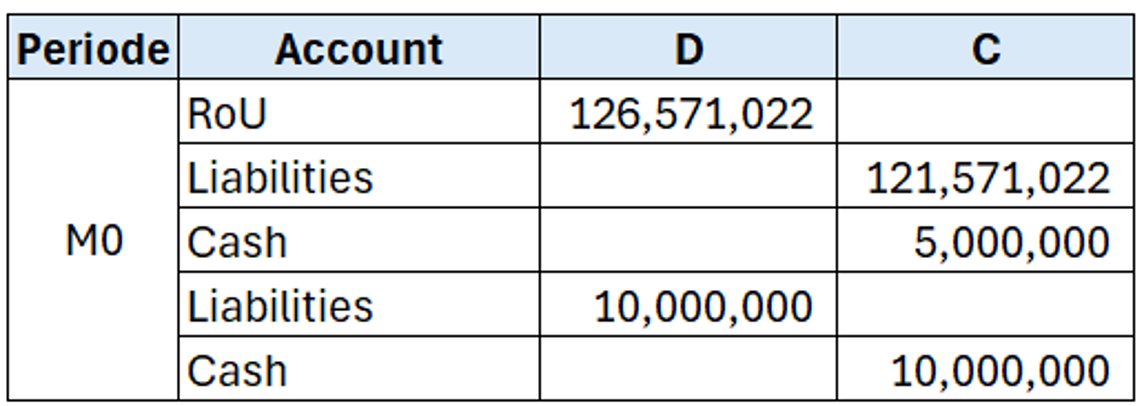
Beginning Journal
1. Initial Recognition (Month 0)
At the inception of the lease, the organization records the total ROU asset, sets up the lease liability, and recognizes the immediate cash outlay for the capitalized renovation:
Debit: Right-of-Use (ROU) Asset — Rp 126,571,022
Credit: Lease Liabilities — Rp 121,571,022
Credit: Cash (Renovation Expenditure) — Rp 5,000,000
When the very first monthly payment is made at the start of Month 0, it reduces the liability directly without incurring interest:
Debit: Lease Liabilities — Rp 10,000,000
Credit: Cash — Rp 10,000,000
2. Monthly Amortization & Payment (Months 1–11)
Throughout the active lease term, monthly entries capture the routine rental payment, the compounding interest expense on the remaining liability, and the straight-line depreciation of the ROU asset. For Month 1, the entries are structured as follows:
Debit: Lease Liabilities (Rental Payment) — Rp 10,000,000
Credit: Cash — Rp 10,000,000
Debit: Interest Expense (0.487% on remaining liability) — Rp 543,078
Credit: Lease Liabilities — Rp 543,078
Debit: Depreciation Expense — Rp 10,547,585
Credit: Accumulated Depreciation — Rp 10,547,585
(Note: The interest expense figure naturally decreases each subsequent month as the outstanding liability principal is reduced.)
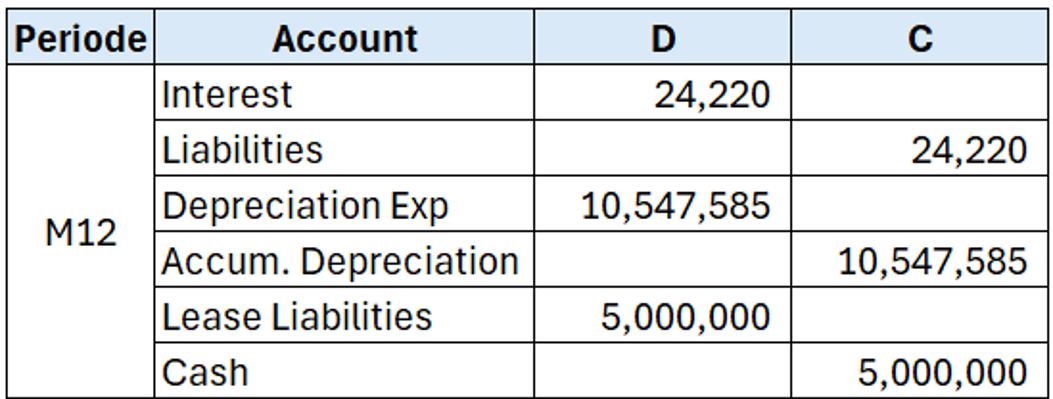
Ending Journal
3. Final Termination and Restoration Settlement (Month 12)
At the end of the contract term, the final interest and depreciation are recognized, bringing the ROU asset value to zero. Simultaneously, the lessee pays the actual cash required to restore the food truck to standard condition, settling the contingency liability established at Month 0:
Debit: Interest Expense — Rp 24,220
Credit: Lease Liabilities — Rp 24,220
Debit: Depreciation Expense — Rp 10,547,585
Credit: Accumulated Depreciation — Rp 10,547,585
Debit: Lease Liabilities (Contingency Settlement) — Rp 5,000,000
Credit: Cash (Restoration Payment) — Rp 5,000,000
The Pitfalls of Manual Lease Management
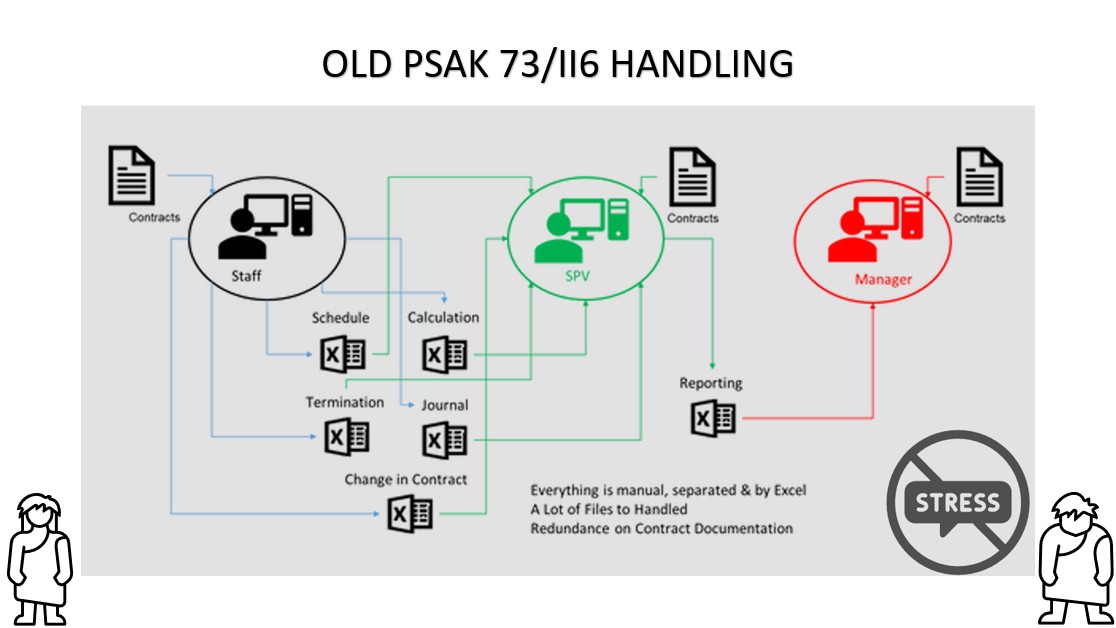
Executing these intricate discounting formulas, asset capitalizations, and contingency tracking across multi-branch organizations using traditional spreadsheets creates severe operational bottlenecks. When contract documentation, payment schedules, and termination calculations are isolated across disconnected Excel files handled by different staff members, organizations face critical risks:
High Vulnerability to Formula Errors: Manual data entry and spreadsheet adjustments inevitably lead to miscalculated present values, incorrect interest amortization, and inaccurate depreciation schedules.
Data Redundancy and Fragmentation: Managing individual Excel files across departments causes version control conflicts and redundant contract documentation.
Compliance and Audit Stress: Manually tracking contract modifications, early terminations, or discount rate changes makes generating consolidated, audit-ready financial statements time-consuming and error-prone.
Automating Financial Compliance with Leasee
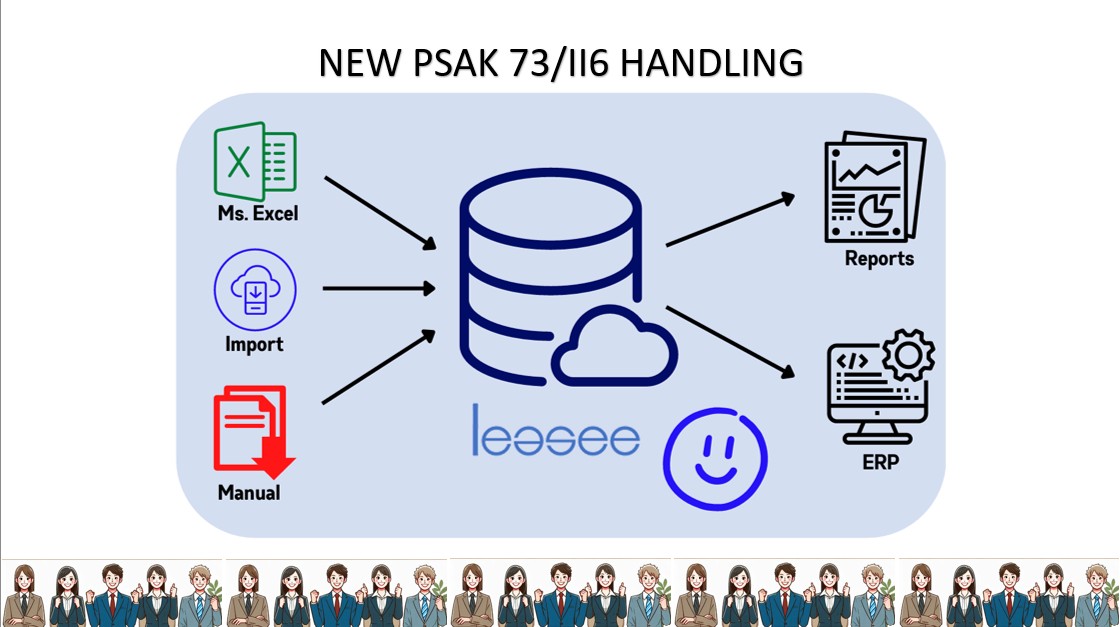
Leasee, developed by PT Sazanka Henig Solusi, is a specialized digital platform engineered to automate lease asset capitalization, contingency tracking, and PSAK 73/116 compliance. By replacing fragmented spreadsheets with an integrated database and automated calculation engine, Leasee transforms lease administration into a transparent, frictionless workflow.
Key Capabilities of the Leasee Platform
Flexible Ingestion & Interactive Validation: Users can input contract details on a per-item basis through intuitive forms or execute bulk entries using standardized CSV templates. Built-in validation checks check parameters during ingestion, dramatically reducing data entry errors.
Automated Schedule & Calculation Engine: The platform instantly computes complex present value discounting, generates comprehensive lease schedules, and maps out exact interest amortization and straight-line depreciation without manual intervention.
Dynamic Contract & Contingency Management: Leasee provides dedicated modules to record initial capitalized costs, track future restoration contingencies, manage mid-term contract amendments (addendums), and execute early or final terminations seamlessly.
One-Click Accounting Journals: The system compiles verified, audit-ready debit and credit journal entries for initial recognition, monthly amortization, and asset returns that can be exported directly into enterprise ERP software.
Multidimensional Reporting & Dashboarding: Finance controllers can extract customizable summaries of liabilities, payment schedules, and asset valuations over configurable time frames to support organizational budgeting and management oversight.
Enterprise Security & Multicurrency Support: Built on robust architecture (PostgreSQL, Node.js, and PHP), Leasee natively handles foreign currency leases and safeguards corporate data through API token authentication, encrypted password storage, CSRF protection, and secure user session management.
Transitioning from manual spreadsheet calculations to Leasee empowers financial controllers and accounting teams to eliminate administrative friction and data redundancy. By centralizing contract records, automating complex discounting formulas, and standardizing reporting outputs, businesses can ensure complete PSAK 73 and PSAK 116 compliance while focusing strategic resources on financial growth and asset optimization
With PT Sazanka Henig Solusi guiding your implementation, Indonesian enterprises gain more than just an automated lease accounting platform. You gain a strategic partner dedicated to building lasting corporate resilience and audit-ready financial transparency. In the face of evolving regulatory standards like PSAK 73 and PSAK 116, the ability to eliminate manual spreadsheet friction, project financial impacts accurately, and act faster is the ultimate key to sustainable business growth.
For further information, product demonstrations, and implementation consultation, contact our expert team:
For more information and consultation, contact our expert:
Are you ready to take your business to the next level? Contact us today to learn how our innovative solutions can help you achieve your goals and drive success

%202.png)