

For most industries, a lease is a line item. For logistics, transportation, and heavy equipment companies, leases are the business. Trucks, trailers, forklifts, excavators, cranes, and warehouse racking are routinely financed through operating and finance lease structures, often numbering in the hundreds of contracts spread across regional branches, multiple lessors, and more than one currency.
That scale is exactly where PSAK 116 compliance becomes a real operational risk, not just an accounting exercise. A single mis-modeled discount rate, a missed contract amendment, or an incorrectly executed Bargain of Purchase Option can distort the right-of-use asset and lease liability balances that now sit directly on the balance sheet, and by extension, distort EBITDA, leverage ratios, and covenant calculations that lenders and boards watch closely.
This article covers the regulatory backdrop, the specific operational risks fleet-heavy companies face when leases are still managed manually, and how LEASEE, SHS's lease accounting automation platform, is built to address exactly this environment.
PSAK 73, Sewa, was issued by DSAK IAI on 18 September 2017 as Indonesia's adoption of IFRS 16, effective for annual periods beginning on or after 1 January 2020. It ended the old operating-lease-versus-finance-lease split for lessees and required almost all leases to be recognized on the balance sheet as a right-of-use asset and a corresponding lease liability.
On 12 December 2022, DSAK IAI renumbered the standard from PSAK 73 to PSAK 116, effective 1 January 2024. This is primarily a codification change: the underlying lessee accounting model (recognition, initial measurement, subsequent measurement, presentation) carries over.
Alongside the renumbering, DSAK IAI also adopted the IASB's amendment on Lease Liability in a Sale and Leaseback, originally issued in November 2022 and effective for annual periods beginning on or after 1 January 2024. This amendment matters specifically to companies that sell assets (such as vehicles or equipment) and lease them back from the buyer: it clarifies how a seller-lessee subsequently measures the lease liability so that no gain or loss is recognized on the right of use it retains, closing a gap left after the initial 2020 adoption of the standard. Companies that use sale-and-leaseback structures to finance fleet or equipment purchases (a common tactic in capital-intensive logistics operations to free up cash) are the ones most directly affected by this specific 2024 change.
Separately, and importantly, Bargain of Purchase Option (BoPO) handling is not new. It has been part of the lease classification and measurement requirements since PSAK 73 was first issued, and it remains one of the more error-prone areas in practice, particularly for heavy equipment leases where an end-of-term purchase option is standard commercial practice (loaders, excavators, and specialized transport equipment are frequently leased with an eventual ownership path in mind). Getting BoPO treatment wrong, in either the lease classification test or the subsequent journal at contract end, is a recurring audit finding, whether or not any new rule changed in 2024.
For a Financial Controller managing a large fleet, the practical takeaway is this: the compliance bar did not move much in principle, but the operational burden of applying it correctly, contract by contract, branch by branch, currency by currency, has not gone away either. If anything, auditors are now more familiar with the standard and more likely to test the details.
Logistics and heavy equipment companies typically manage lease portfolios that manual spreadsheets were never designed for:
• High contract volume: hundreds of vehicle, trailer, and equipment leases active at any time, often originated at different branches with different lessors and different terms.
• Complex discount factor work: recalculating a discount rate, and every downstream schedule, every time a contract is amended, terminated early, or extended, is manual, repetitive, and easy to get wrong.
• Multi-currency exposure: imported trucks and heavy equipment are frequently financed or priced in USD or JPY, which means lease liabilities and right-of-use assets need to be revalued using appropriate average and closing rates every period, on top of the underlying PSAK 116 calculation.
• Fragmented data: contract files, payment schedules, and supporting documents scattered across branch folders, email threads, and personal spreadsheets, with no single source of truth for Head Office to consolidate from.
• Variable payment structures: full upfront payment, payment at the start or end of each period, monthly versus annual terms, and elements such as capitalized costs, residual values, and lease incentives all need to be modeled consistently.
• Human error at scale: a single formula slip in a spreadsheet with hundreds of linked contracts is very hard to catch before it reaches the trial balance, and very hard to trace back once it has.
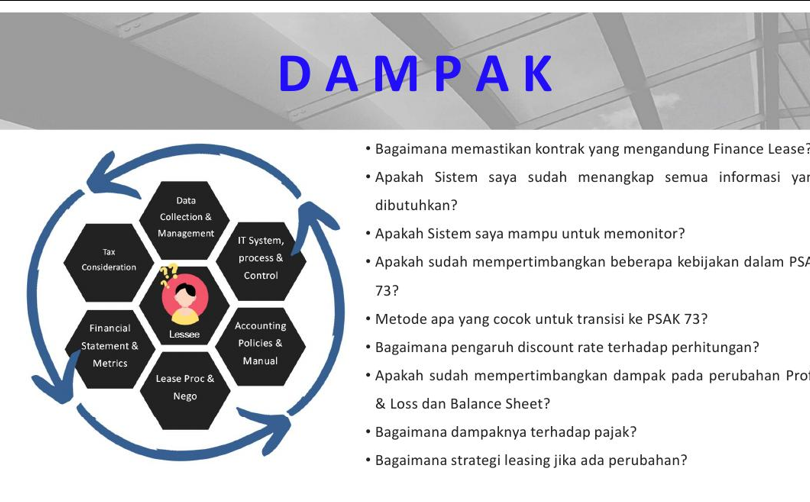
LEASEE is SHS's lease accounting automation platform, purpose-built to help Lessee companies apply PSAK 116 (and IFRS 16) consistently, across every branch and every contract, without rebuilding a spreadsheet model every time something changes.
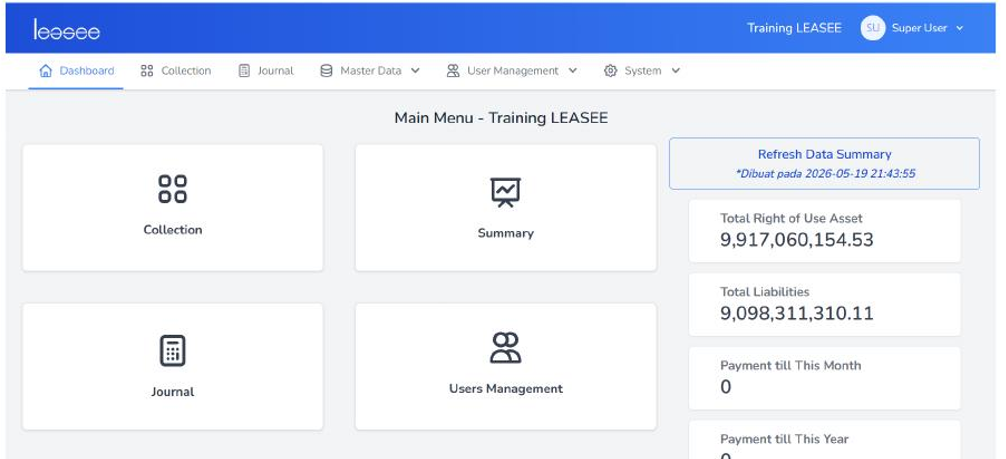
At its core, LEASEE follows astraightforward flow: Input, Draft, Process, Output. Contracts are enteredmanually or imported in bulk, checked in a Draft stage before calculation,processed through Collection (the detailed period-by-period schedule), Changein Contract, or Early/Ending Termination as needed, and finally output asaccounting journals and management reports.
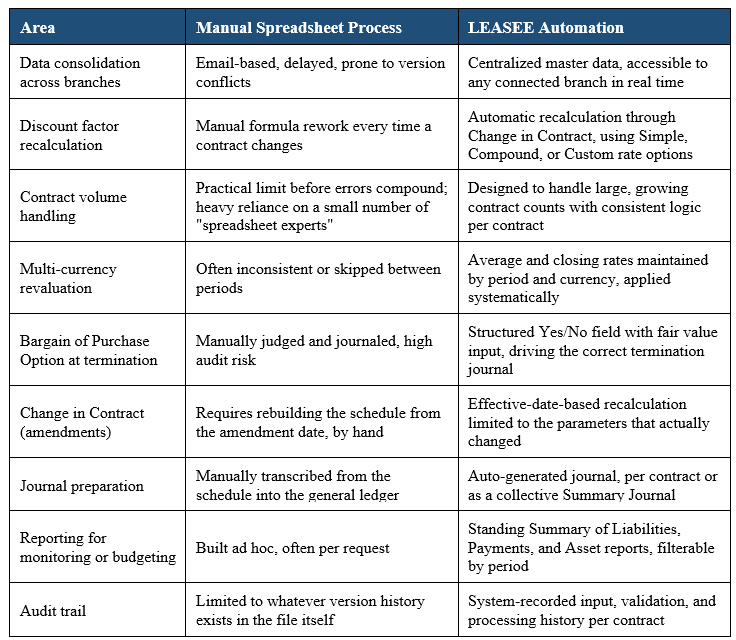
Rather than each branch maintaining its own contract log, LEASEE centralizes master data (Accounting Area, Asset Class, Business Unit, Cost Center, Profit Center, Contract Lessor, Contract Owner, Currency, Country, and related reference tables) in one system accessible to any branch with an internet or intranet connection. This removes the email-based reconciliation cycle that typically happens at month-end when Head Office tries to consolidate branch-level lease data.
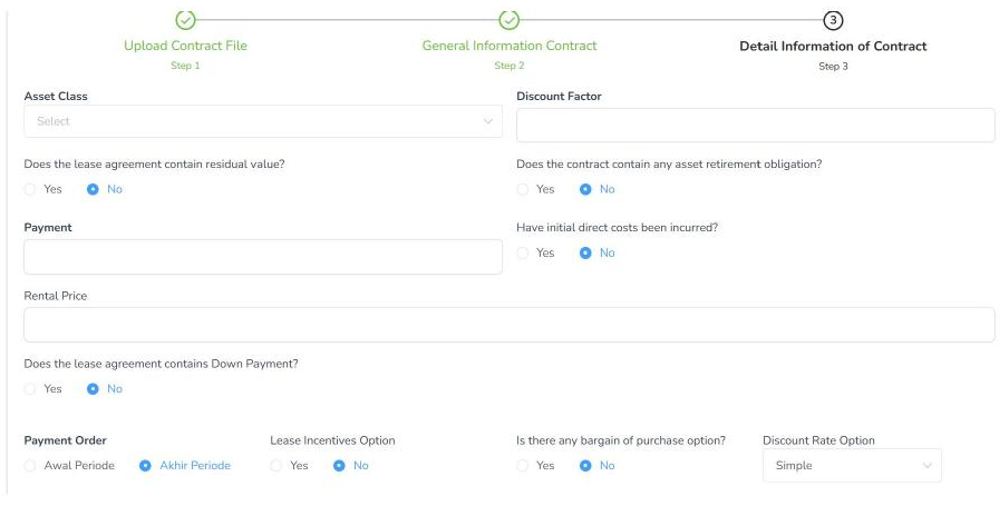
Contracts can be entered one at a time through a guided, multi-step form (Upload Contract File, General Information, Detail Information), or in bulk through a CSV import template. Either way, the same finance lease classification survey and field validation apply, so a contract cannot be saved with inconsistent or incomplete data. This directly reduces the human error risk that comes from copy-pasting figures across dozens of spreadsheet tabs.
Once a contract is in Draft and confirmed, LEASEE's Collection engine generates the full period-by-period schedule automatically, covering beginning and ending liability, interest, principal, and rate changes, based on the discount rate option selected for that contract (Simple, Compound, or Custom). This is the single biggest time and error risk in a manual process: every time a rate or term changes, the entire remaining schedule needs to be recalculated by hand. LEASEE does this automatically and consistently.
Fleet and equipment leases are renegotiated often (extended terms, revised payment amounts, changed incentives, or an adjusted discount factor). LEASEE's Change in Contract feature lets a user record the effective date of the update and only the specific parameters that changed, then automatically recalculates the schedule and journals from that point forward, without requiring a brand-new contract to be built from scratch.
When a lease is terminated early, LEASEE calculates the termination journal based on the selected period and any termination penalty entered. When a lease reaches its natural end, the Ending Termination flow specifically asks whether the Bargain of Purchase Option is being executed, and generates the correct journal entries (including fair value of the leased asset) accordingly. This is precisely the area flagged earlier as a recurring compliance risk, and it is treated as a structured, auditable step in LEASEE rather than a manual, ad hoc calculation.
For companies financing imported vehicles or equipment in USD, JPY, or other foreign currencies, LEASEE maintains average and closing exchange rates by period and currency, and applies the closing rate consistently in the underlying calculation. This removes a common source of quiet balance sheet drift, where a foreign-currency lease liability is revalued inconsistently, or not at all, between periods.
Every processed contract produces a standard accounting journal (initial recognition, interest expense, depreciation, and any termination or fiscal adjustment entries), which can be pulled individually or as a Summary Journal across a chosen date range. Beyond the journal, LEASEE also produces Summary of Liabilities, Summary of Payments, and Summary of Asset reports, filterable by period, so Financial Controllers can monitor portfolio-level exposure without rebuilding a report from scratch every month.
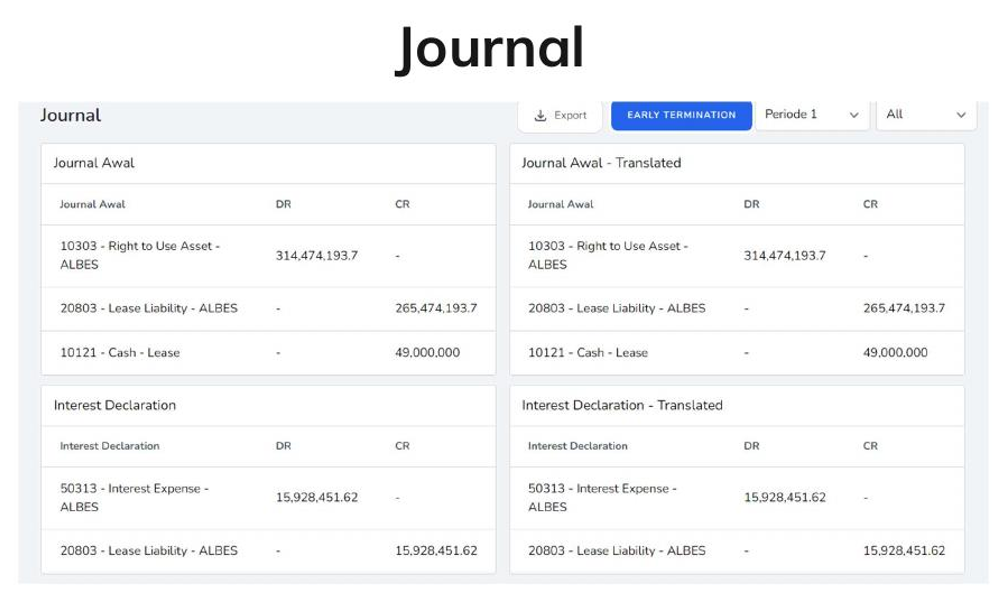
The scenario below is a hypothetical, illustrative example built to demonstrate how LEASEE would process a representative logistics and heavy equipment contract set. It does not describe an actual SHS client, and no figures in this section should be read as real financial results, benchmarks, or projections.
PT Armada Cipta Logistik (fictional) operates a fleet of 120 container trucks and 18 pieces of heavy equipment (forklifts and yard cranes) across four branches in Java and Sumatra. Roughly a third of the fleet is financed in JPY through a leasing arrangement tied to imported truck chassis, with the remainder in IDR.
In this hypothetical scenario, one heavy equipment contract, a yard crane leased under a five-year term, includes a Bargain of Purchase Option exercisable at the end of the lease, with monthly payments due at the end of each period and a Simple discount rate applied at inception. Midway through year three, the branch renegotiates the payment amount as part of a broader fleet refresh discussion with the lessor.
Under a manual process, this single change would require the branch's finance team to rebuild the remaining 24 months of the amortization schedule by hand, re-check the discount factor, and manually update the interest and principal split going forward, then notify Head Office so the consolidated liability report could be corrected before month-end close.
Using LEASEE, the same event is handled through the Change in Contract feature: the user selects the contract, enters the effective date of the update and the new payment amount, and the system recalculates the remaining schedule and journal entries from that date forward. When the lease reaches its end, the Ending Termination flow prompts for whether the Bargain of Purchase Option is executed and the fair value of the asset, and generates the corresponding journal automatically, with the JPY-denominated contracts revalued using the period's closing rate as part of the same process.
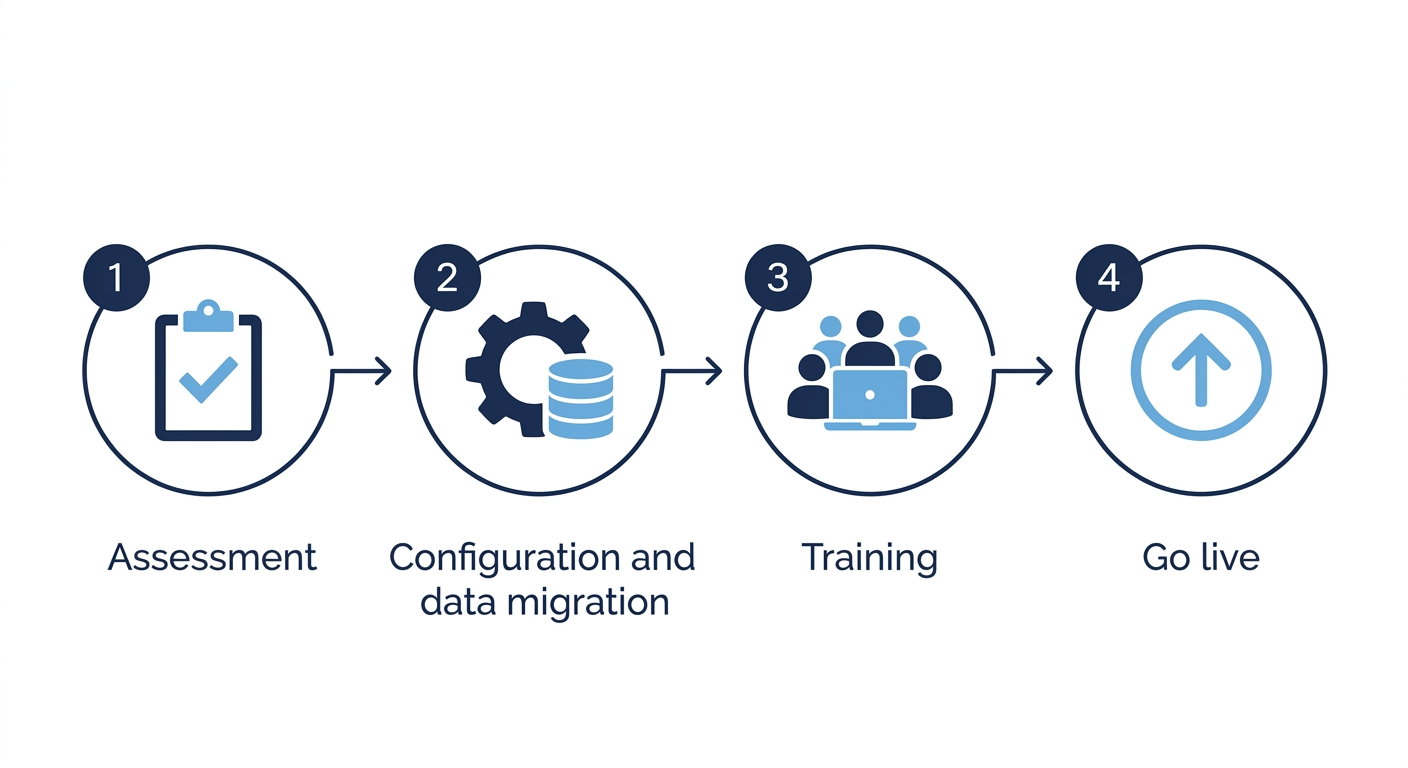
Moving from spreadsheets to LEASEE is typically structured in a small number of stages, adapted to the size and complexity of the portfolio being migrated:
• Master Setting Assessment: reviewing the existing chart of accounts, branch structure, and lease portfolio to define how master data (Asset Class, Cost Center, Profit Center, Contract Lessor, and others) should be configured.
• System Installation and Configuration: setting up the environment and mapping the relevant general ledger accounts to LEASEE's Asset Class structure.
• Data Migration: importing existing contracts (individually or via the bulk CSV template), validating each one against the finance lease classification checks before calculation.
• Training: walking finance and branch teams through Input, Draft, Collection, Change in Contract, and Termination workflows.
• Go Live: switching over reporting and journal generation to LEASEE, with the legacy spreadsheet retained temporarily as a parallel check during the first close cycle.
PT Sazanka Henig Solusi (SHS) is a Jakarta-based technology company. LEASEE is SHS's dedicated lease accounting automation platform for PSAK 116 and IFRS 16 compliance. SHS also delivers other, separate technology solutions as part of its broader portfolio, including DivaSystem and UiPath-based robotic process automation, which serve a different set of clients (including Haleyora and Toyota Astra Motor) for use cases unrelated to lease accounting. These engagements are distinct from LEASEE's client base and are noted here only to give a full picture of SHS's technology portfolio.
For logistics, transportation, and heavy equipment companies, PSAK 116 compliance is not a one-time project. It is a recurring operational discipline applied to a portfolio that is constantly changing: new contracts, amendments, early terminations, and purchase options being exercised, across multiple branches and currencies. LEASEE is built to make that discipline sustainable, with centralized data, automated calculation, and a structured audit trail, so Finance teams can spend less time rebuilding spreadsheets and more time on analysis.
PT Sazanka Henig Solusi built LEASEE specifically to automate PSAK 73, PSAK 116, and IFRS 16 compliance from contract intake through journal generation and portfolio-wide reporting. To see the platform run the calculations this article detailed, using your own fleet and branch structure, multi-currency equipment leases, and Bargain of Purchase Option terms, contact PT Sazanka Henig Solusi to schedule a customized demonstration.
Please contact our expert:
Hananto Pandu SE., S.Kom., Ak., CA., CPA., ASEAN CPA. - 0896 3626 1684
Best Regards,
Yohannes Ekaputra Sananto SE. MSc.
yohannes.sananto@sazankahenig.com
Financial Product Consultant
PT Sazanka Henig Solusi
Sazanka Henig Solusi is a Jakarta-based enterprise technology partner delivering simple, integrated, and intuitive solutions across Enterprise Performance Management, business intelligence, process automation, generative AI, compliance, HR technology, and cybersecurity — helping Indonesian enterprises turn complex business transformation into a lasting competitive advantage.
Are you ready to take your business to the next level? Contact us today to learn how our innovative solutions can help you achieve your goals and drive success
Get Started%202.png)