
For Indonesian FMCG leaders, uncertainty stopped being an abstraction sometime in the last eighteen months. It shows up every morning in the rupiah's opening print, in a tariff notice out of Washington, in a shipping schedule to Ambon or Jayapura that slipped by four days. None of these events, taken alone, is unusual for an archipelago economy of this scale. What has changed is the frequency, and the speed with which they compound.
The enterprises weathering this best are not the ones with the single most accurate forecast. They are the ones whose finance, supply chain, and commercial teams are working from the same forecast, continuously updated, rather than three separate ones reconciled once a quarter. That capability, connected enterprise planning, is quickly becoming the difference between absorbing volatility and being surprised by it.
Three forces are doing most of the work:
Layer consumer behavior on top of all this. Government social assistance and a Ramadan-driven surge in early 2026 pushed demand for daily essentials up even as shoppers stayed price-sensitive on anything discretionary, per industry research covering the period, while traditional trade, warungs and independent retailers, still moves the majority of FMCG volume nationally. Essential-goods resilience running through a highly fragmented, geographically dispersed channel is exactly the kind of demand pattern that rewards granular, region-by-region forecasting and punishes anything built on a single national average.
Ask most FMCG finance, supply chain, and commercial teams what next quarter looks like, and the answers usually come from three different points in the month, built on three different sets of assumptions. Finance is modeling the rupiah and input costs. Supply chain is forecasting regional demand and lead times. Commercial and merchandising are planning assortment and promotions. Each function is working with a real signal. None of them is working with the same one.
That gap is tolerable when conditions are stable. It becomes expensive the moment they are not. A currency move finance clocks on Monday does not reach the supply chain team's reorder point until the next planning cycle, weeks later. A tariff change announced in Washington shows up as a landed-cost surprise months after the underlying decision was made. For a business running its cost and demand models on a quarterly, or even monthly, cycle, each of these events lands as an after-the-fact correction rather than a scenario that was already on the table.
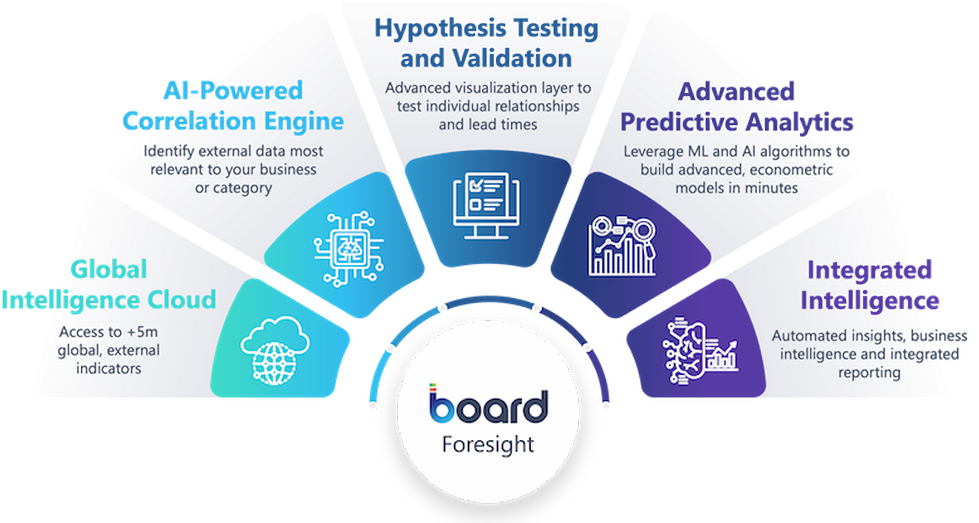
Board Foresight, the AI forecasting layer of the Board Intelligent Planning Platform, is built around a simple premise: one forecast, one platform, referenced by every function and updated continuously rather than rebuilt from scratch each cycle. Board calls this decision coherence, and it rests on five capabilities working together:
Underneath this sits agentic AI, Board Agents, operating inside the planning model itself rather than beside it. Instead of a planner discovering a problem buried in a monthly variance report, the agent is already watching: comparing the live forecast to actual performance, running scenarios quietly in the background, and surfacing a meaningful gap the moment it appears rather than at the next scheduled review.
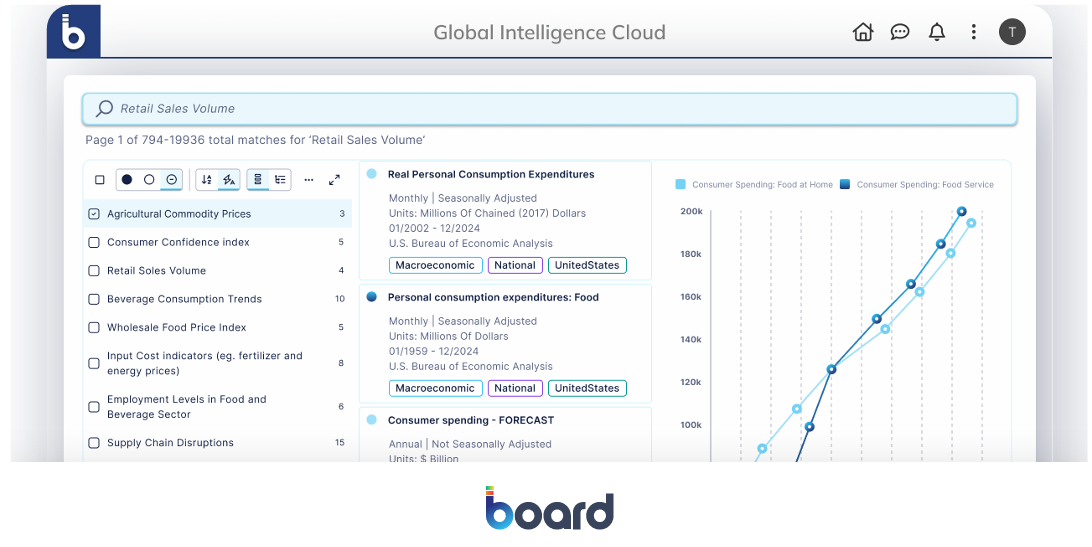
For an Indonesian FMCG business, the external signals that matter rarely show up in a standard financial data feed. Consumer confidence readings, retail sales trends, wholesale food price indices, input-cost indicators for fertilizer and energy, employment levels in the food and beverage sector, and early indicators of supply chain disruption all move the numbers that finance and supply chain teams are trying to forecast, often weeks before that movement shows up in a company's own sales data.
Board calls this category Market Signals: leading indicators, not lagging ones, surfaced automatically rather than hunted down manually across a dozen government and industry data portals. Combined with a business's own SKU-level sales history, Market Signals let a regional planner see a retail sales trend or an input-cost spike coming and adjust a forecast before it becomes a missed number, rather than explaining it after the fact.
Given how often the rules of Indonesia's own trade exposure have changed this year, treating a tariff rate as a fixed input is itself a risk. Board Foresight's scenario planning capability lets a team build baseline, upside, and downside cases anchored to current tariff and currency assumptions rather than a year-old one, then update those assumptions the moment a new trade decision is announced rather than waiting for the next budget cycle.
For a CFO or supply chain director, the practical value is not a perfect prediction of the next tariff announcement. It is having the modeled range of outcomes, and a rough sense of the margin and inventory implications of each, already built before the announcement lands, so a policy shift becomes a scenario the organization already discussed rather than a fire drill.

The following is an illustrative composite built from patterns common across Indonesian FMCG distribution. It is not an account of any single named company.
PT Nusantara Cipta Pangan is a national packaged food and beverage producer distributing across Sumatra, Java, Kalimantan, Sulawesi, and the eastern provinces.

The outcomes above are not aspirational. They track closely with what Board Foresight reports across its deployed base:
For an Indonesian FMCG business, those four numbers map directly onto the pressures covered above: fewer empty shelves when a shipping window is missed, less capital tied up in safety stock held against uncertainty a live forecast can now anticipate, and planning teams spending their time looking forward rather than explaining what already happened.
None of this requires a planner to remember to go looking for a problem. Board Agents sit inside the model, continuously comparing the live forecast to actual sell-through, running what-if scenarios in the background, and surfacing an alert, a regional demand surge, a widening gap between budget and forecast, a supply risk on a key input, the moment it crosses a meaningful threshold, alongside a recommended action rather than just a number.
For a regional FMCG planning team covering several island clusters at once, that shift, from a planner hunting for problems in a report to an agent surfacing them proactively, is often the difference between catching a shortage two weeks out, while there is still time to reroute stock, and discovering it the week the shelf actually goes empty.

None of the forces covered here, the rupiah, tariff policy, archipelago logistics, are going to stop moving. That is simply the operating environment for FMCG in Indonesia now, and treating it as a temporary disruption to wait out is itself a risk. The organizations pulling ahead are the ones that have stopped trying to forecast around volatility and started planning inside it, with one continuously updated view of demand, cost, and risk shared across finance, supply chain, and commercial teams instead of three competing spreadsheets reconciled once a month.
That is the shift Sazanka Henig Solusi helps Indonesian enterprises make, bringing Board Foresight and the wider Board Intelligent Planning Platform into organizations that already carry real operational complexity, and doing it simply, in an integrated way, and intuitively enough that finance, supply chain, and commercial teams actually use it day to day.
Board EPM provides the technology foundation for this transformation. Sazanka Henig Solusi provides the local context, implementation expertise, and ongoing support that ensures that foundation genuinely delivers real business value for mining companies in Indonesia.
For organizations ready to begin the journey toward continuous planning, the most effective first step is not overhauling every process at once, but choosing one area of high volatility to prove the value first. The momentum built from that early success matters far more to long-term outcomes than how broad the scope attempted in the first phase happens to be.
Schedule a demo or consultation with PT Sazanka Henig Solusi. Please contact our expert:
Hananto Pandu SE., S.Kom., Ak., CA., CPA., ASEAN CPA. - 0896 3626 1684
Best Regards,
Yohannes Ekaputra Sananto SE. MSc.
yohannes.sananto@sazankahenig.com
Financial Product Consultant
PT Sazanka Henig Solusi
Sazanka Henig Solusi is a Jakarta-based enterprise technology partner delivering simple, integrated, and intuitive solutions across Enterprise Performance Management, business intelligence, process automation, generative AI, compliance, HR technology, and cybersecurity, helping Indonesian enterprises turn complex business transformation into a lasting competitive advantage.
Are you ready to take your business to the next level? Contact us today to learn how our innovative solutions can help you achieve your goals and drive success
Get Started%202.png)