
Why connected, AI-assisted planning is becoming a leadership priority, and how Board EPM and Sazanka Henig Solusi help institutions get there.
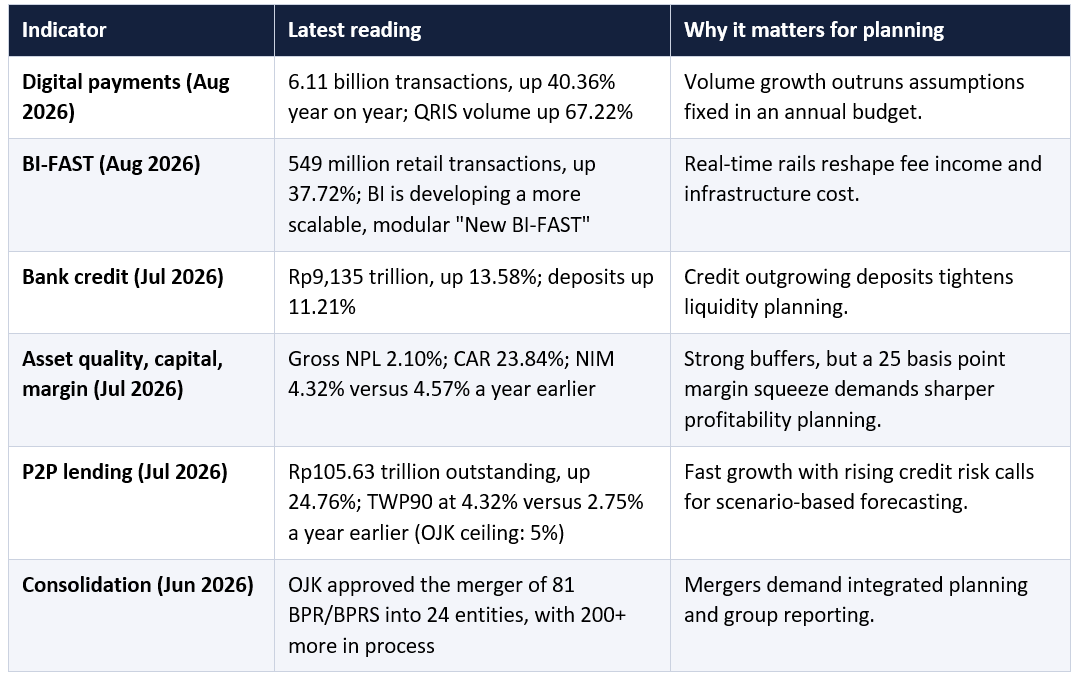
Indonesia's financial sector is growing faster than the planning processes that steer it. In July 2026, bank credit stood at Rp9,135 trillion, up 13.58% year on year, and digital payment volumes keep compounding. At the same time, margins are tighter, regulators expect AI that can be explained and audited, and consolidation is redrawing the competitive map.
Annual budgets built on disconnected spreadsheets were not designed for this pace. This article looks at what is changing, where finance teams feel the strain, and how modern Enterprise Performance Management (EPM), specifically Board EPM, helps institutions plan continuously instead of retrospectively.
The latest readings from Bank Indonesia (BI) and the Financial Services Authority (OJK) describe a sector that is scaling quickly, well capitalized, and under growing structural pressure.
Regulatory maturity is rising, and AI is inside the perimeter. OJK issued its AI governance guidance for Indonesian banks on 29 April 2025, promoting human-centric AI that is understandable and auditable, with tighter oversight for high-impact uses such as lending. Legal commentators read the guidance as a signal of OJK's wider expectations, including for fintech providers. OJK Regulation 29 of 2024 on alternative credit scoring already emphasizes governance, risk management and consumer data protection, and OJK Regulation 16 of 2025 on fit and proper tests for financial technology operators took effect on 1 October 2025.
Digital payments are now the default rail. BI reports that QRIS has about 67 million users and targets 69.32 million by the end of 2026, while it modernizes the infrastructure behind BI-FAST and BI-RTGS to absorb the load.
Consolidation continues at every tier. Commercial banks operate under a Rp3 trillion minimum core capital framework (OJK Regulation 12/2020), and the rural bank segment is merging at pace. On 9 September 2026, OJK's head of banking supervision encouraged digital banks to consider consolidation to strengthen scale, capital efficiency and technology investment.
Put together, the picture is more volume, thinner margins, higher expectations for transparency, and structural change. Planning has to become continuous to keep up.
Behind these headline figures, finance and strategy teams in banks, multi-finance companies and fintechs describe a consistent set of obstacles.
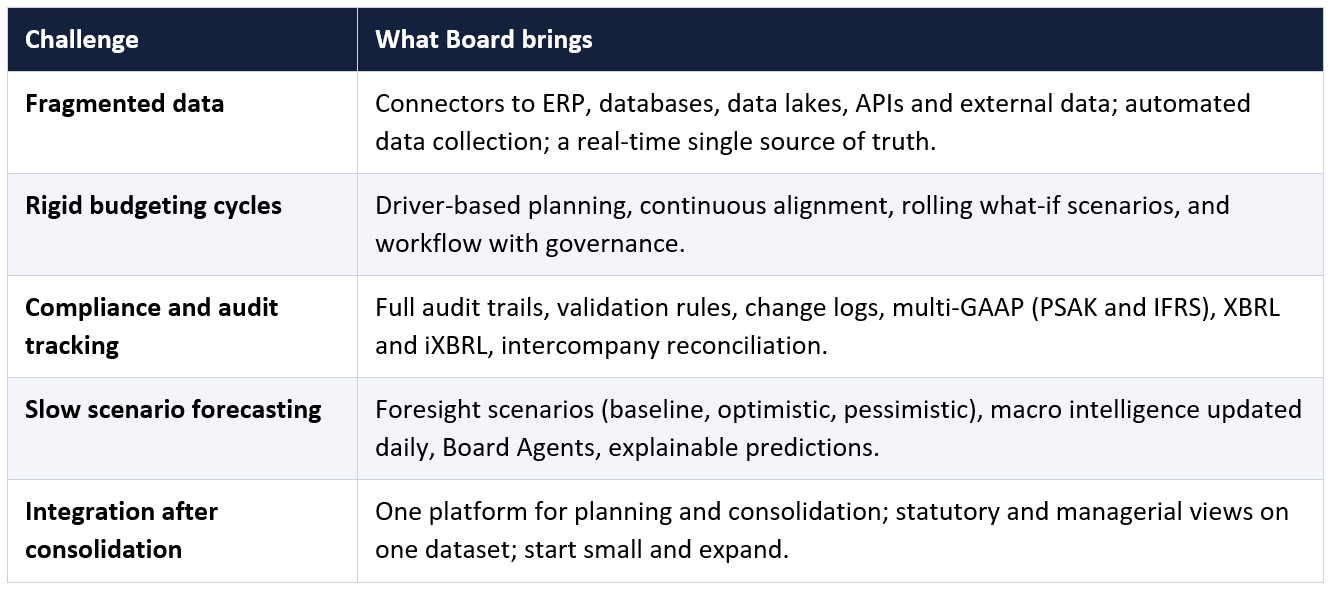
• Fragmented data. Core banking, loan origination, treasury, risk and HR data often sit in separate systems stitched together by spreadsheets. Board's own diagnosis is that spreadsheets are everywhere, data and report preparation takes too much effort, and teams lack confidence in the numbers. When a CFO cannot trust a figure, every downstream decision slows.
• Rigid budgeting cycles. An annual budget fixes assumptions about volumes, funding cost and credit quality. With payment volumes up roughly 40% and bank margins down 25 basis points in a year, those assumptions can age within a quarter.
• Compliance and audit tracking. Teams must reconcile statutory, managerial and regulatory views of the same numbers, evidence how models reach their conclusions, and keep intercompany positions clean across group structures, often under both PSAK and IFRS.
• Slow scenario forecasting. When fintech lendingTWP90 moves from 2.75% to 4.32% in a year, leaders need to know quickly what further deterioration would mean for provisioning, funding and capital. Rebuilding that scenario by hand in spreadsheets can take days.
• Integration after consolidation. Mergers combine charts of accounts, planning calendars and reporting packs. Without a common planning model, the combined entity spends its first year reconciling rather than steering.

Board is an enterprise planning platform used by more than 2,000 organizations. It unifies planning, budgeting, forecasting, consolidation and reporting in one environment, with AI and analytics built in. Board materials cite its recognition as a Leader in the 2023 Gartner Magic Quadrant for Financial Planning Software, and describe a go-to-market partnership with Microsoft for its Azure cloud-based offering.
One platform for connected planning
Board connects to legacy systems, APIs, databases and data lakes, ERP and CRM applications, IoT feeds and external providers, then layers planning, automation, intelligence and reporting on top. Business users build and maintain models through a no-code interface, which reduces dependence on IT queues, and Office 365 and Power BI add-ins keep analysts in familiar tools. Security capabilities listed in Board's materials include data encryption with bring-your-own-key, a central identity provider, contextual user access and change logs. Institutions can start with a single use case and expand across the enterprise at their own pace.
Intelligent planning and continuous forecasting
Board's intelligent planning approach combines driver-based planning, business rules and allocations, workflow and governance, and scenarios and simulations, backed by in-memory calculation designed for speed. Explainable predictions are a stated design principle, which is directionally consistent with the transparency OJK expects from AI in finance (each institution should still validate this against its own model risk policy).
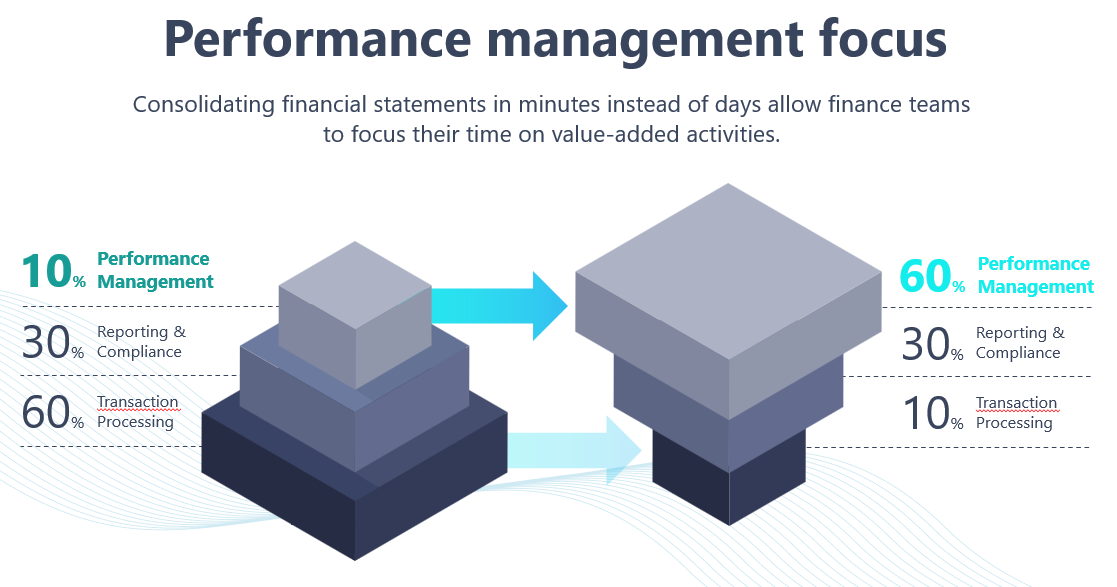
Board Foresight adds AI forecasting that unifies econometric forecasting for strategic and financial plans with operational forecasting at granular levels. It draws on more than 5.5 million global datasets from over 10,000 sources, across 168 industries and 8 macro sectors, updated daily. Teams can build baseline, optimistic and pessimistic scenarios, adjust key assumptions, and receive plain-language explanations generated by AI. Board Agents then monitor performance inside the planning model, simulate scenarios and surface insights, so teams can switch to a Plan B or Plan C when conditions shift instead of waiting for month-end. Board calls the result decision coherence: strategy, execution and executive reporting all reference the same enterprise signal.
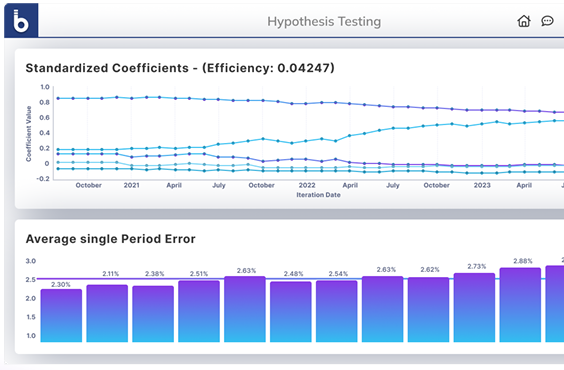

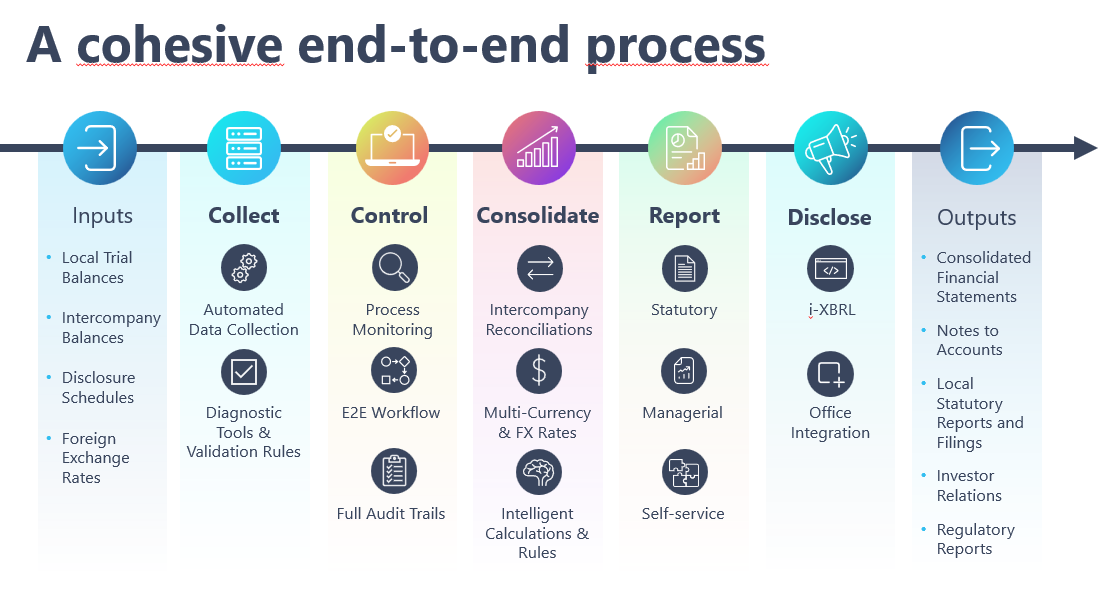
Board Group Consolidation and Reporting extends the platform into the financial close. It automates collection of local trial balances, intercompany balances, disclosure schedules and FX rates, applies diagnostic and validation rules, tracks workflow, and keeps full audit trails. It supports multi-GAAP adjustments on a single dataset (including PSAK and IFRS), multi-currency translation, an intercompany reconciliation dashboard, and XBRL and iXBRL disclosure, with native integration to Excel, PowerPoint and Word. Board illustrates the intent as shifting finance effort away from transaction processing and toward performance management.
The following results come from Board's own materials:
• Forrester's Total Economic Impact study of the Board Intelligent Planning Platform cites 335% ROI with payback in under six months.
• One customer reports that a report run dropped from 25 minutes to 1.5 seconds, and that a scenario plan that took 10 hours now takes 2 seconds.
• An Office of Finance reports efficiency rising from 57%to 91%.
• Customer outcomes in Board's flyer include automating 90%of financial data input, cutting data transfer from 24 hours to 15 minutes, anda 75% reduction in planning cycle time.
• Board states that forecast accuracy can exceed 90% when external data is included.
These are customer-reported results from organizations across industries, and Foresight's published benchmarks lean on demand forecasting. They are not Indonesian banking outcomes. We recommend validating them against your own drivers, such as loan growth, funding cost, NIM, provisioning and fee income, during a proof of value.
Technology alone does not change how an institution plans. Board's materials stress user experience that supports adoption and change management, and the flexibility to begin with one use case. Both depend on the partner guiding the program.
Sazanka Henig Solusi is a Jakarta-based technology partner headquartered at Menara Karya, Jl. HR Rasuna Said. Its company profile describes three commitments: being client centric (understanding client goals and delivering in a timely manner), technology-forward (continuous improvement using the best technology in the market), and focused on quality assurance (excelling from initiation to maintenance). Its brand promise is Simple, Integrated, Intuitive, and it lists Board as its Enterprise Planning Platform.
What distinguishes Sazanka for financial institutions is an integrated portfolio around the EPM core:
• Data foundation: Dr.Sum consolidates large volumes of company data, and MotionBoard provides real-time visualization and dashboards.
• Automation: UiPath and Microsoft Power Automate remove repetitive, rule-based data tasks from the planning cycle.
• Accounting compliance: Leasee automates PSAK 73and IFRS 16 lease accounting and integrates with ERP and accounting systems.
• Generative AI: AISA is a chatbot built on OpenAI models and Microsoft Azure, adaptable to a client's own documents and databases, with controls over knowledge sources and data privacy.
• Cybersecurity: managed vulnerability management, penetration testing, a 24/7 Security Operation Center, managed detection and response, and cyber threat intelligence, developed around the current threat landscape and compliance needs.
A sensible path to start. The steps below follow Board's start-small-and-expand design. They are a suggested approach, and scope and timing would be agreed during discovery:
1. Choose one high-value use case, for example margin andliquidity scenario planning, or group consolidation and reporting.
2. Connect the core data sources and run a proof of value against your own drivers.
3. Settle early the questions regulated institutions careabout most: hosting and data residency options, access and security design, anddocumentation of how forecasts are produced, aligned with OJK guidance.
4. Expand to budgeting, rolling forecasts and widerplanning domains at the pace the organization can absorb.
None of the forces covered here, from fast-growing payment volumes and compressing margins to rising regulatory expectations and ongoing consolidation, are going to stop moving. That is simply the operating environment for Indonesian banking, fintech, and financial services now, and treating it as a temporary disruption to wait out is itself a risk. The institutions pulling ahead are the ones that have stopped trying to forecast around volatility and started planning inside it, with one continuously updated view of performance, cost, and risk shared across finance, risk, treasury, and business teams instead of competing spreadsheets reconciled once a month.
That is the shift Sazanka Henig Solusi helps Indonesian enterprises make, bringing Board Foresight and the wider Board Intelligent Planning Platform into organizations that already carry real operational complexity, and doing it simply, in an integrated way, and intuitively enough that finance, risk, and business teams actually use it day to day.
Board EPM provides the technology foundation for this transformation. Sazanka Henig Solusi provides the local context, implementation expertise, and ongoing support that help ensure that foundation genuinely delivers real business value for banks, fintechs, and financial services institutions in Indonesia.
For organizations ready to begin the journey toward continuous planning, the most effective first step is not overhauling every process at once, but choosing one area of high volatility to prove the value first, for example margin and liquidity scenario planning, or group consolidation and reporting. The momentum built from that early success matters far more to long-term outcomes than how broad the scope attempted in the first phase happens to be.
Schedule a demo or consultation with PT Sazanka Henig Solusi. Please contact our expert:
Hananto Pandu SE., S.Kom., Ak., CA., CPA., ASEAN CPA. - 0896 3626 1684
Best Regards,
Yohannes Ekaputra Sananto SE. MSc.
yohannes.sananto@sazankahenig.com
Financial Product Consultant
PT Sazanka Henig Solusi
Sazanka Henig Solusi is a Jakarta-based enterprise technology partner delivering simple, integrated, and intuitive solutions across Enterprise Performance Management, business intelligence, process automation, generative AI, compliance, HR technology, and cybersecurity, helping Indonesian enterprises turn complex business transformation into a lasting competitive advantage.
Are you ready to take your business to the next level? Contact us today to learn how our innovative solutions can help you achieve your goals and drive success
Get Started%202.png)