
.png)
Right now, inside finance departments, operations floors, and back offices across Indonesia, some of the most capable people in your organization are doing some of the least capable work.
They're copying numbers from one system into another. Re-keying invoice data. Chasing down email attachments. Cross-checking spreadsheets line by line before month-end close. A 2025 study commissioned by HP found that the average office worker now spends roughly **half of their working day** on tasks like copy-pasting, manual data entry, and searching for files — work that requires almost no judgment, yet consumes the bulk of the workday. Any executive who has run a time-and-motion audit inside their own finance or operations team will recognize the pattern immediately.
That's not a talent problem. It's an architecture problem. Most enterprise systems — ERPs, tax portals, legacy databases, government platforms — were never designed to talk to each other. So businesses fill the gap with people, doing by hand what software should be doing automatically.
For more than a decade, Robotic Process Automation has offered a way out. But RPA itself is now undergoing its own transformation — from rule-following software robots to autonomous AI agents capable of reasoning, adapting, and deciding. Understanding that shift, and choosing the right partner to implement it, may be the single highest-leverage IT decision an Indonesian enterprise makes this year.
In the next five minutes, you'll learn:
- Why the cost of manual work is now a strategic liability, not just an inefficiency
- How UiPath's Studio, Orchestrator, and Attended/Unattended robots work together
- What "Agentic Automation," Autopilot, and Large Action Models mean for your business
- A real Banking & Finance case study with tens of millions of dollars in documented savings
- How PT Sazanka Henig Solusi turns this technology into results for Indonesian enterprises

At its foundation, UiPath is the world's leading Robotic Process Automation platform — software that deploys "bots" to do exactly what a trained employee would do inside a computer system, just faster, more consistently, and without needing a coffee break.
Traditional RPA, the kind that has already transformed thousands of back offices worldwide, works in three essential ways:
- Interacting with interfaces like a human would — clicking buttons, filling forms, navigating menus, and reading screens across desktop apps, web portals, SAP, and legacy systems exactly the way an employee's fingers and eyes would.
- Running quietly in the background — executing scheduled or triggered jobs on a server with no one watching, so overnight reconciliations, batch uploads, and report generation happen while the office sleeps.
- Following clearly defined rules, precisely — a bot built in UiPath doesn't improvise. It executes the exact logic a business analyst designs, which is precisely why it delivers near-perfect accuracy on repetitive, well-defined tasks.
This is delivered through three components any serious UiPath deployment relies on:
- UiPath Studio — a drag-and-drop workflow designer where automation is built visually, using pre-built activities that already know how to talk to SAP, databases, SharePoint, email, and hundreds of other systems.
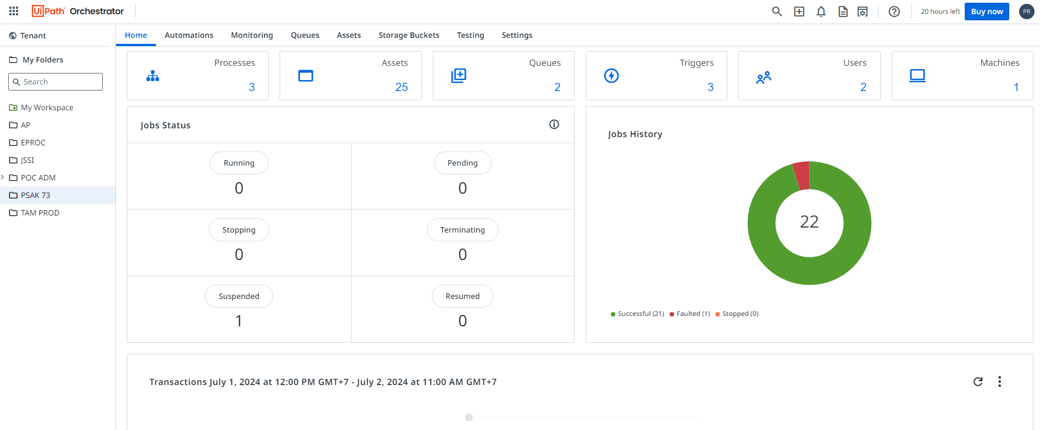
- UiPath Orchestrator — the centralized command center that deploys, schedules, monitors, and governs every robot in the organization, manages credentials and assets securely, and gives IT full visibility into what's running, when, and why.
- Attended and Unattended Robots — Attended robots sit beside an employee, triggered on demand for tasks like help-desk workflows or guided form-filling. Unattended robots run independently on a schedule or trigger, ideal for high-volume, back-office-critical work like reconciliations, invoice processing, and batch reporting.
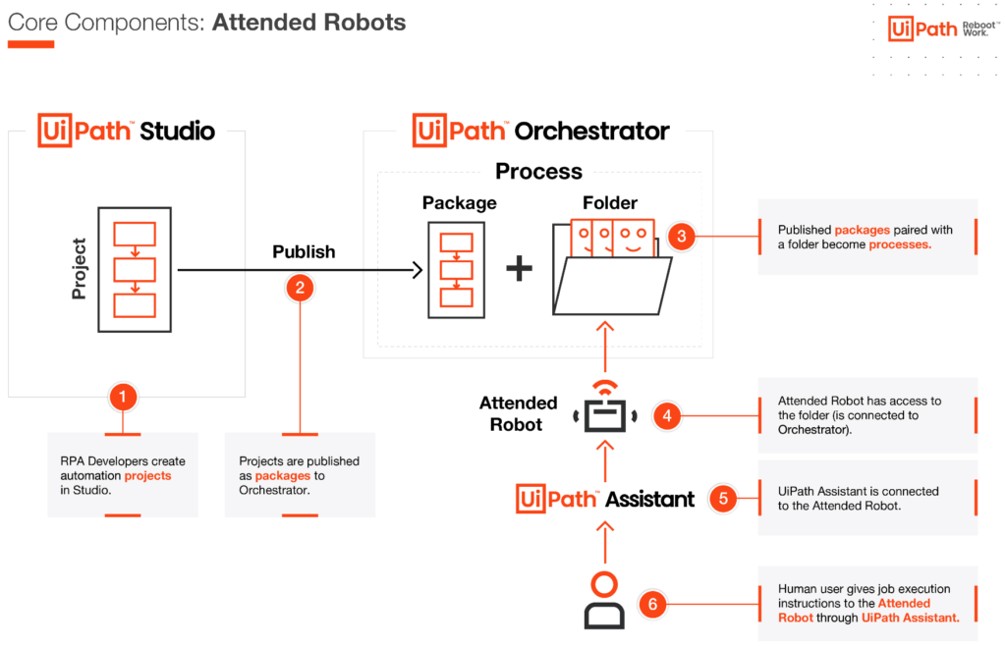
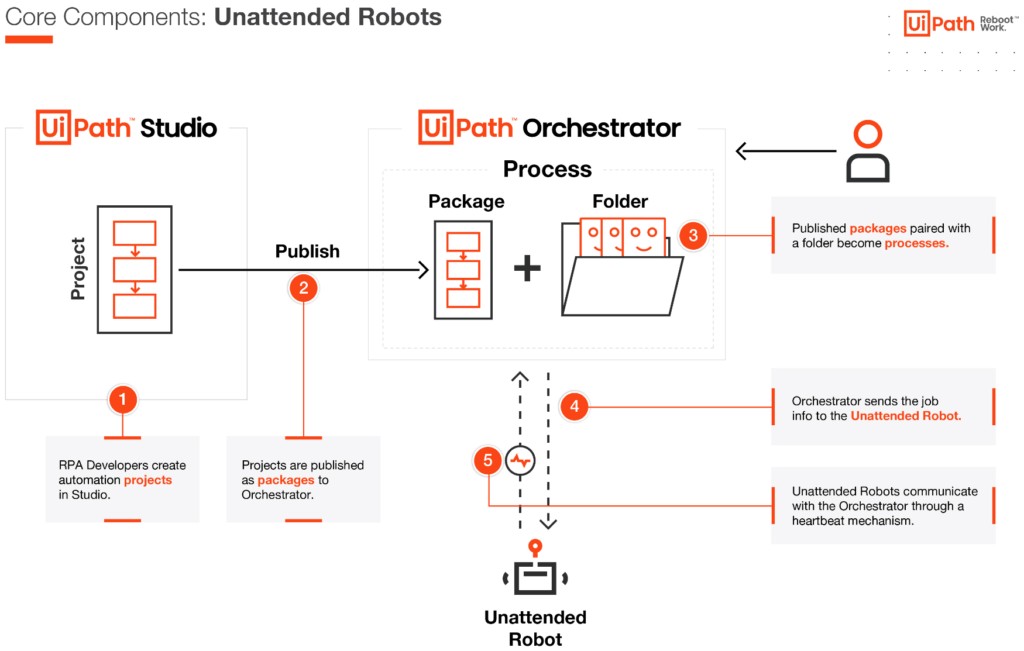
That's the RPA most people know — and it works brilliantly. But it has a ceiling. A rule-based bot is a bit like a brilliant intern who follows instructions to the letter but freezes the moment something unexpected happens. Hand it a scanned invoice with a slightly different layout, an email with no clear subject line, or a decision that requires judgment, and it stops and waits for a human.
That ceiling is exactly why UiPath's next chapter matters.
UiPath is now investing heavily in what it calls Agentic Automation — sometimes described as cognitive automation — and it changes the fundamental nature of what a "bot" can do.
Instead of following a rigid, pre-programmed script, an AI agent built on UiPath's platform can interpret a goal, reason about the best way to achieve it, adapt when the underlying data or interface changes, and make context-aware decisions along the way — much closer to how a skilled employee would handle an unfamiliar situation.
A few of the building blocks driving this shift:
- UiPath Autopilot — AI built directly into the platform that helps teams build, run, and troubleshoot automations faster, grounded in the actual context of your workflows rather than acting like a generic chatbot.
- Agent Builder — a low-code environment for designing autonomous agents that plan multi-step actions rather than execute a single fixed script.
- Large Action Models (LAMs) — where a large language model can write and reason about text, a Large Action Model goes a step further: it translates instructions into real, executable actions inside enterprise applications, letting an agent describe *what* needs to happen in natural language and actually carry it out on-screen.
- UiPath Maestro — an orchestration layer that coordinates agents, robots, and human reviewers together across a single long-running business process, rather than a single isolated task.
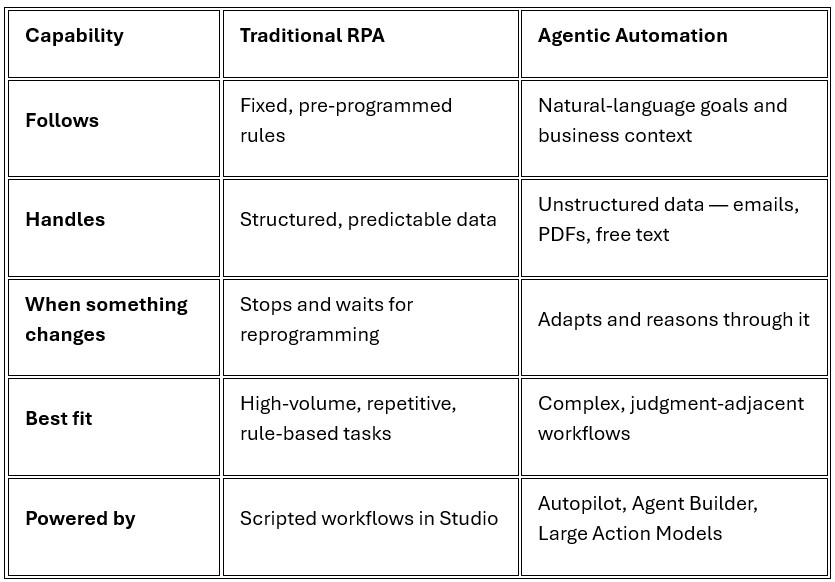

The practical difference is enormous. A traditional bot processing an invoice needs every possible format and field mapped out in advance. An agentic system can look at an invoice it has never seen before, extract meaning even when the layout is unstructured, decide how to handle an exception, and escalate to a human only when genuine judgment is needed — all while every action remains logged, auditable, and governed.
This is the shift from automation that executes instructions to automation that understands intent.
Powerful technology is only half the equation. The other half is knowing how to deploy it inside the specific reality of Indonesian enterprise — local tax regulations, government platforms, ERP configurations, and change-management realities that no out-of-the-box software license can solve alone.
That's where PT Sazanka Henig Solusi comes in.
Founded in April 2016 and headquartered at Menara Karya, South Jakarta, Sazanka has built its identity around a simple promise embedded in its own motto: "Simple, Integrated, Intuitive." The company's mission centers on delivering innovative, reliable, and customized technology solutions that drive measurable efficiency and growth — built on a foundation of client-centric service, rigorous quality assurance, and continuous technology improvement. RPA implementation sits at the core of how that promise gets delivered.
Sazanka's UiPath methodology is built around the same three pillars covered above, tailored to each client's environment:
- Studio-based workflow design, mapped directly onto how a client's finance, tax, or operations team actually works today — not a generic template.
- Orchestrator-driven governance, so every robot is scheduled, monitored, and secured centrally, with full audit trails for compliance-sensitive processes.
- A tailored mix of Attended and Unattended robots, matched to the task at hand — Attended for on-demand, human-supervised work; Unattended for scheduled, high-stakes back-office processes that need to run flawlessly, every time, without supervision.
In practice, this has meant building automations such as:
- An unattended robot that runs daily, unsupervised, pulling data from SAP and internal systems, reconciling the figures automatically, and submitting completed tax invoice data directly into Indonesia's tax authority platform — turning a process that once demanded daily manual attention into a background job that simply runs before the office opens.
- Automated vendor communication workflows, where robots read incoming vendor emails, validate the data against business rules, request corrections automatically when something's missing, and push clean, verified data straight into internal systems, with no manual triage required.
- Document Understanding-powered pipelines, where robots extract and validate data from complex, high-field PDFs, queue exceptions for quick human review through UiPath's Action Center, and store verified results directly into enterprise databases — a workflow that sits right at the boundary between classic RPA and today's agentic, AI-assisted document processing.
Because Sazanka's expertise extends beyond RPA — into conversational AI (AISA), finance lease compliance under PSAK 73 and IFRS 16 (Leasee), and enterprise planning and BI (Board and MotionBoard) — clients get something a pure software reseller cannot offer: a single, accountable partner who understands how automation, data, and enterprise systems fit together as one architecture.
Nowhere is the value of this technology more visible than in Banking & Finance — specifically, corporate tax compliance and reconciliation, where the margin for error is measured in real money and regulatory exposure.
Consider one well-documented example from UiPath's global network of implementation partners. A major financial institution's Tax Compliance and Quality Assurance team was responsible for depositing roughly US$1.5 billion annually in withholding taxes. Every deposit depended on manually pulling data from multiple systems — daily, weekly, monthly, and quarterly — to perform intricate reconciliations before each filing deadline. The volume made errors almost inevitable: in a single year before automation, mistakes led to approximately US$35 million in incorrectly remitted withholdings, on top of the ever-present risk of penalties, interest charges, and regulatory examination for late or inaccurate filings.
After deploying UiPath robots to extract the underlying data, cross-reference it against source systems, flag discrepancies, and automatically regenerate reports when something didn't reconcile, the transformation looked like this:
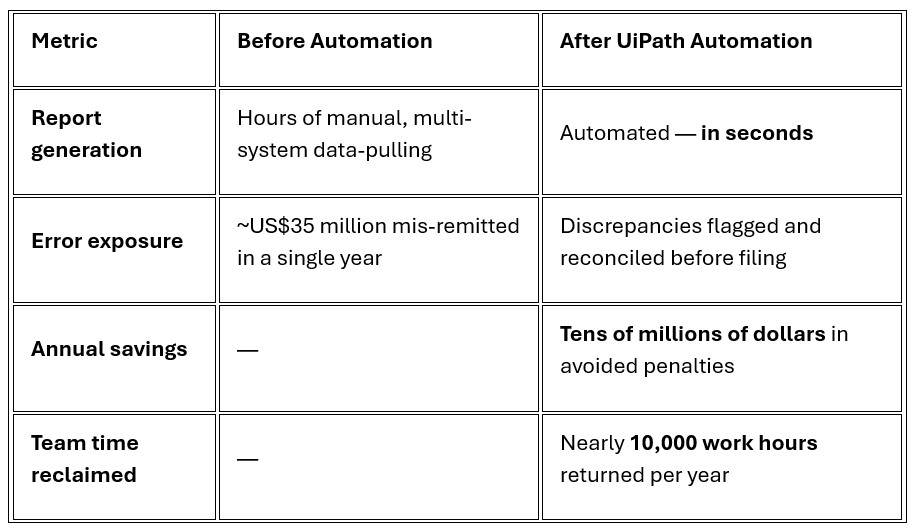

This isn't a story that only plays out in New York or London. The same pattern exists inside Indonesian enterprises today. Swap "IRS" for Indonesia's Direktorat Jenderal Pajak (DJP), and "withholding deposits" for daily *Faktur Pajak* (tax invoice) reconciliation, and the risk profile looks strikingly familiar: tight deadlines, multi-system data pulls, and real financial exposure the moment something slips through. It's precisely this kind of process — high-volume, rule-intensive, deadline-driven, and unforgiving of error — that Sazanka has already automated for clients here in Indonesia, using the same unattended-robot architecture.
The lesson scales globally and locally at once: wherever money, deadlines, and manual reconciliation intersect, the cost of staying manual isn't neutral. It compounds, quarter after quarter.
The organizations that lead their industries over the next five years won't be the ones with the most software licenses. They'll be the ones that turned automation from a cost-cutting afterthought into a core operating capability, freeing their best people from repetitive, error-prone work so they can focus on judgment, strategy, and growth.
UiPath has already proven what's possible, from classic RPA through today's agentic, decision-making automation. The remaining question for most Indonesian enterprises isn't *whether* to automate. It's *who* can implement it correctly, securely, and in a way that actually fits how your organization runs.
That's the role PT Sazanka Henig Solusi exists to play: a local partner combining deep UiPath expertise with hands-on experience across Indonesian tax compliance, ERP environments, and enterprise architecture, delivered with the same promise the company was built on — Simple, Integrated, Intuitive.
Ready to eliminate your organization's manual bottlenecks for good?
For further information, product demonstrations, and implementation consultation, contact our expert team:
For more information and consultation, contact our expert:
Hananto Pandu SE., S.Kom., Ak., CA., CPA., ASEAN CPA. - 0896 3626 1684
Best Regards,
Yohannes Ekaputra Sananto SE. MSc.
yohannes.sananto@sazankahenig.com
Financial Product Consultant
PT Sazanka Henig Solusi
Sazanka Henig Solusi is a Jakarta-based enterprise technology partner delivering simple, integrated, and intuitive solutions across Enterprise Performance Management, business intelligence, process automation, generative AI, compliance, HR technology, and cybersecurity — helping Indonesian enterprises turn complex business transformation into a lasting competitive advantage.
Are you ready to take your business to the next level? Contact us today to learn how our innovative solutions can help you achieve your goals and drive success
Get Started%202.png)