
AN ANALYSIS FOR CFOs, FINANCIAL CONTROLLERS& ACCOUNTING MANAGERS IN MULTI-UNIT FOOD & BEVERAGE
By PT Sazanka Henig Solusi
Strip away the menus, the kitchens, and the brand, and a multi-unit food and beverage company is, structurally, a real estate portfolio business. Every new outlet the business opens is a new lease contract, and under PSAK 73, its 2024 amendment PSAK 116, and their IFRS equivalent, IFRS 16, nearly every one of those contracts now lands on the balance sheet as a Right-of-Use (RoU) asset and a matching lease liability. For a chain running 20 outlets, that is a manageable governance task. For a chain running 150 or 300, it is an entirely different order of operational and audit risk, and it is precisely where most F&B finance teams still lean on spreadsheets built for a smaller, simpler business.
A restaurant chain rarely leases one type of space twice. A single portfolio typically spans several distinct lease profiles at once, each with its own commercial logic and its own accounting consequences:
• Mall anchor and food-court outlets: typically three- to five-year base terms with renewal options, tenant fit-out obligations, and rent tied to a minimum guarantee, a percentage of sales, or both.
• Cloud kitchens and dark kitchens: often shorter, more flexible terms in industrial or shared-kitchen facilities, but frequently renewed in practice as a delivery-only brand scales, which affects how the lease term is judged for accounting purposes.
• Food trucks and mobile units: sometimes structured as an asset lease rather than a property lease, but still meeting the definition of a lease wherever the operator controls the use of an identified vehicle or unit over time.
• Standalone and drive-through units: longer-term ground or building leases that behave more like conventional commercial property leases, often with the largest individual capitalized values in the portfolio.
Each of these is, on its own, a manageable calculation. Multiplied across a growing footprint, they become a portfolio of individually negotiated cash flow streams, discount rates, and contractual triggers that must each be tracked with precision, every month, for the life of the contract.
Jakarta mall landlords, like most sophisticated commercial landlords, rarely price a lease as a flat monthly amount for the full term. It is common practice to offer a lower opening rate while a new outlet builds its customer base, then step the rent upward at fixed points in the contract, alongside periodic escalations built into longer agreements and, in many cases, a percentage-of-sales clause layered on top of a minimum guaranteed rent.
This matters far beyond cash flow planning. PSAK 73 and IFRS 16 require the lease liability to be measured at the present value of the actual, contracted future payments, period by period, not an averaged or straight-lined estimate. A stepped rent schedule therefore requires a discrete discounted cash flow calculation for every rent tier, correctly sequenced against the payment dates. A single incorrect assumption about when a step takes effect, carried across a spreadsheet built for dozens of outlets, is an error that compounds silently until an auditor, or a restatement, finds it.
F&B fit-outs are capital-intensive relative to the underlying lease value. A single new outlet can involve a commercial kitchen exhaust and ventilation system, grease trap and gas line installation, walk-in chiller units, custom booth and counter joinery, and brand-specific finishes, well before the first transaction is rung up.
Under the initial recognition rules of PSAK 73 and IFRS 16, initial direct costs incurred by the lessee to prepare the asset for its intended use are added to the initial measurement of the RoU asset, not expensed as incurred. For F&B outlets, this frequently means the RoU asset recognized on the balance sheet is materially larger than the lease liability, a gap that is easy to miscalculate by hand and one that directly changes monthly depreciation and every EBITDA-adjacent metric the business reports afterward.
Most mall and commercial landlord agreements obligate the tenant to restore the unit to shell condition, or to its original state, at the end of the lease: removing custom millwork and signage, patching floors and walls, and de-installing kitchen exhaust ducting. When this obligation is probable and its cost can be reliably estimated, it must be recognized as a provision and capitalized into the RoU asset at its present value as of the commencement date.
Because the restoration cost sits at the far end of the contract, it needs its own discounting logic, and its own accretion (discount-unwinding) schedule running in parallel with the main lease liability, converging to the full, undiscounted restoration estimate exactly at the point the outlet closes or the lease ends. Section 2 of this article walks through exactly how that convergence is calculated and verified.
Rent renegotiations, term extensions, partial closures of underperforming outlets, and mid-term relocations within the same mall are routine events in F&B portfolios, not exceptions. Under PSAK 73, most of these events qualify as a lease modification, which generally requires the lease liability to be remeasured, often at a revised discount rate, with a corresponding adjustment flowing through the RoU asset. Each modification effectively restarts part of the schedule from the effective date forward, for that one outlet, without disturbing the others.
None of the mechanics above are unmanageable in isolation. What breaks down is doing all of them, correctly and consistently, across a growing, changing portfolio, in Excel. The recurring failure modes finance teams report are consistent:
• Formula drift: copy-paste errors and broken cell references compound silently across dozens of outlet tabs built at different times by different people.
• Inconsistent discount rates: without a governed, single source of truth, different reviewers apply slightly different incremental borrowing rate assumptions to similar contracts.
• No durable audit trail: after a rent renegotiation or partial termination, it is difficult to reconstruct who changed which assumption, when, and why, which is exactly what an external auditor will ask.
• Version control chaos: hundreds of outlet-level files, each independently maintained, make it difficult to be confident that the figures rolling up into the consolidated financial statements are current.
• Slow, high-risk month-end close: manual reconciliation across every outlet consumes days that a growing finance team increasingly cannot spare.
• Elevated restatement risk: a single structural formula error, discovered late, can force a correction across every period it touched.
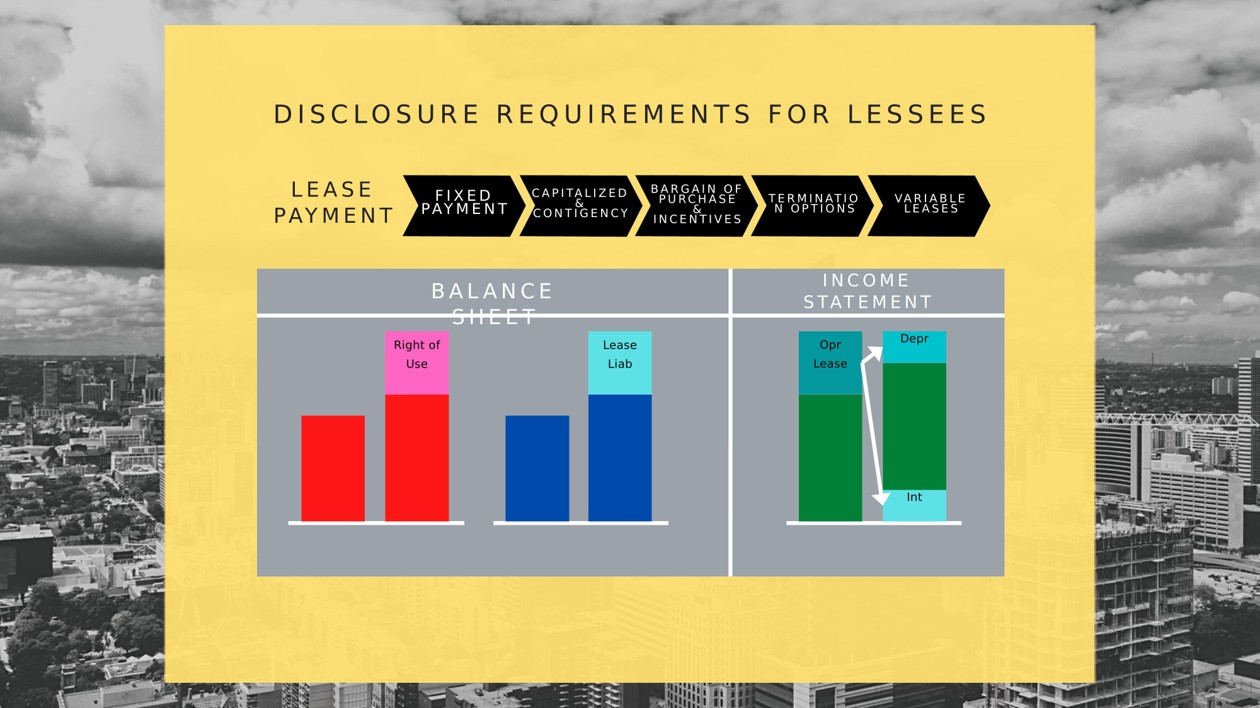
To make Section 1's mechanics concrete, this section works through a single, representative outlet lease in full: every formula, every period of the amortization schedule, and every journal entry from commencement to lease end. The figures below are an illustrative, hypothetical scenario built to demonstrate the calculation methodology; they are not the financial results of any actual Sazanka Henig Solusi client. The methodology, discount convention, and schedule structure mirror the worked examples used in PT Sazanka Henig Solusi's own PSAK 73/116 technical training material, applied here to a new, F&B-specific scenario that combines a stepped rental structure, a capitalized fit-out cost, and a restoration contingency in a single contract, exactly the combination described in Section 1.
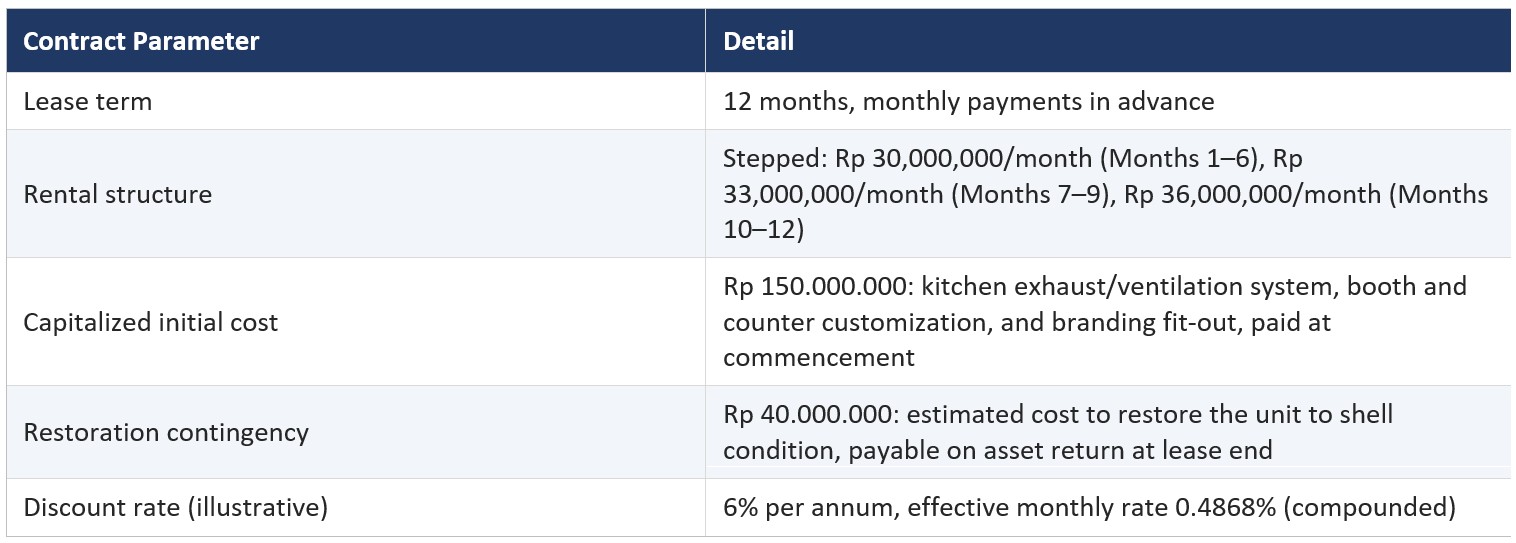
Kedai Rasa (a hypothetical brand name used purely for illustration) is opening a new kiosk-format outlet in a Jakarta shopping mall, one of many such openings planned for the year. The commercial terms agreed with the mall operator are as follows:
The lease liability is recognized at the present value of the lease payments and the present value of the restoration contingency. The RoU asset adds the capitalized fit-out cost on top of that same base:
• Lease Liability = PV(lease payments) + PV(restoration contingency)
• Right-of-Use Asset = PV(lease payments) + PV(restoration contingency) + Capitalized cost
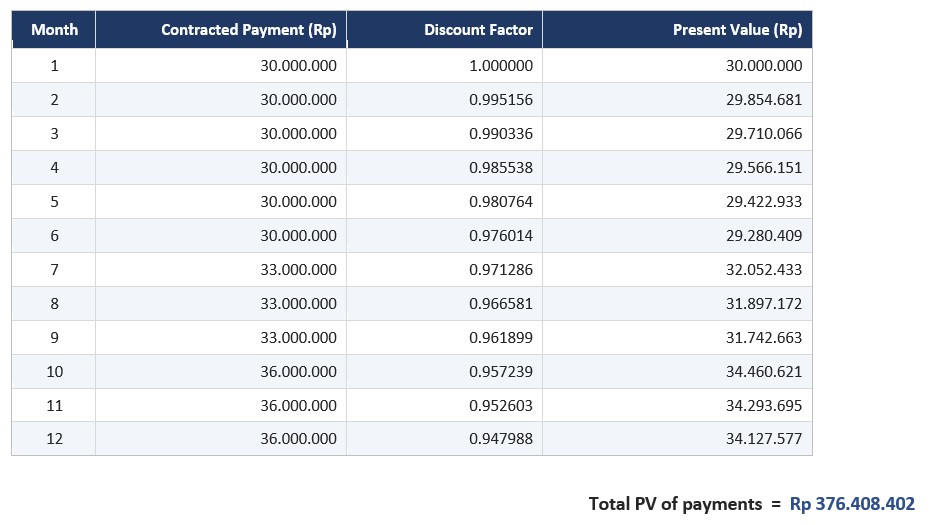
Present value of the stepped payment stream
Because payments are made in advance, the Month 1 payment is not discounted (it coincides with commencement); each subsequent month's payment is discounted by one additional month at the effective monthly rate:
Present value of the restoration contingency
The restoration cost is payable in full at lease end, 12 months from commencement, and is discounted over the full term at the same rate:
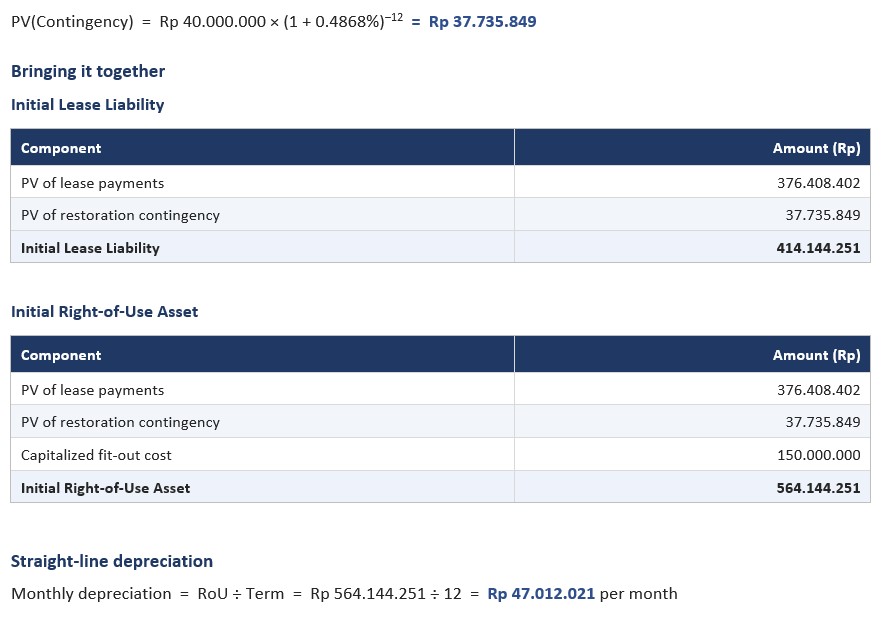
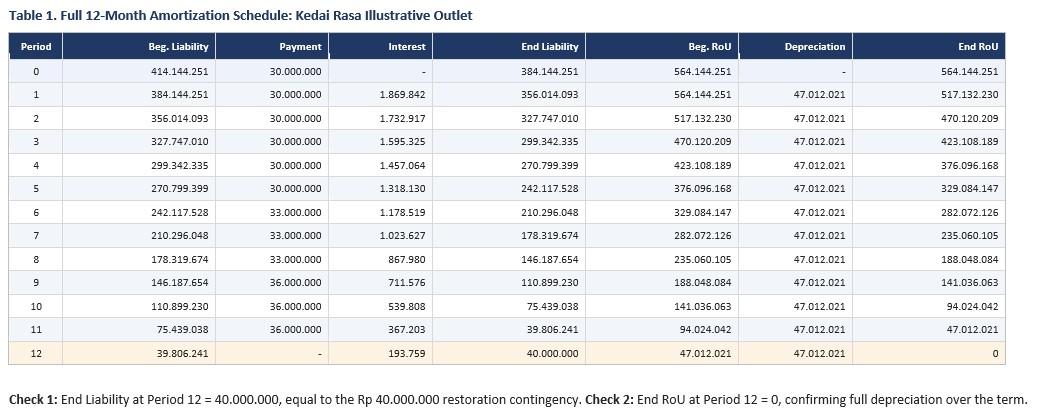
The schedule below carries both the lease liability and the RoU asset from commencement (Period 0) through lease end (Period 12). Two identities must hold if the calculation is correct, and both are the checks LEASEE runs automatically on every contract in a portfolio:
1. the closing lease liability at Period 12 must equal exactly the undiscounted restoration contingency, since the payment stream has been fully extinguished and only the accreted restoration obligation remains; and
2. the closing RoU asset at Period 12 must equal exactly zero, since the asset has been fully depreciated over the lease term.
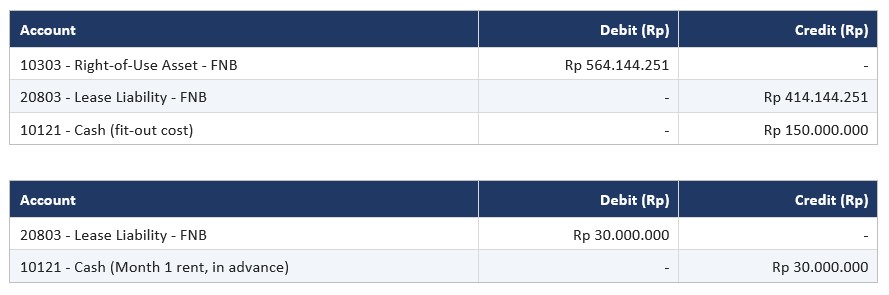
Account codes below (prefixed “FNB” for this F&B asset class) are illustrative. In practice, each account maps to the entity's own chart of accounts through the platform's GL mapping configuration, so the codes shown are for illustration and are fully configurable per client.
Month 0: Commencement
At commencement, the full Right-of-Use asset and Lease Liability are recognized, the capitalized fit-out cost is paid, and the first month's rent (payable in advance) is settled immediately.
Every month, three things happen: the lease liability accretes interest at the effective monthly rate, that month's contracted rent is paid against the liability, and the RoU asset is depreciated on a straight-line basis. Because this is a stepped-rate contract, the payment amount changes at each rent tier, and the interest figure changes every single month as the outstanding liability balance moves. Depreciation alone stays constant, since it is straight-line dover the fixed 12-month term. Three representative months, one from each rent tier, are shown below; the full period-by-period figures for every month appear in Table 1.
Month 1 (Tier 1rent, Rp 30.000.000/month)
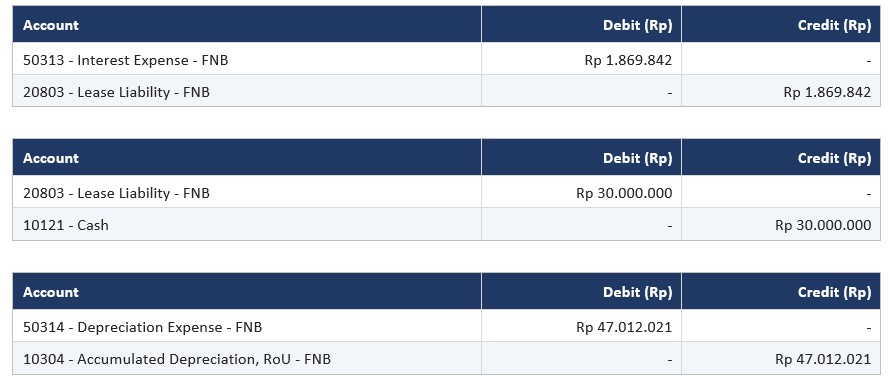
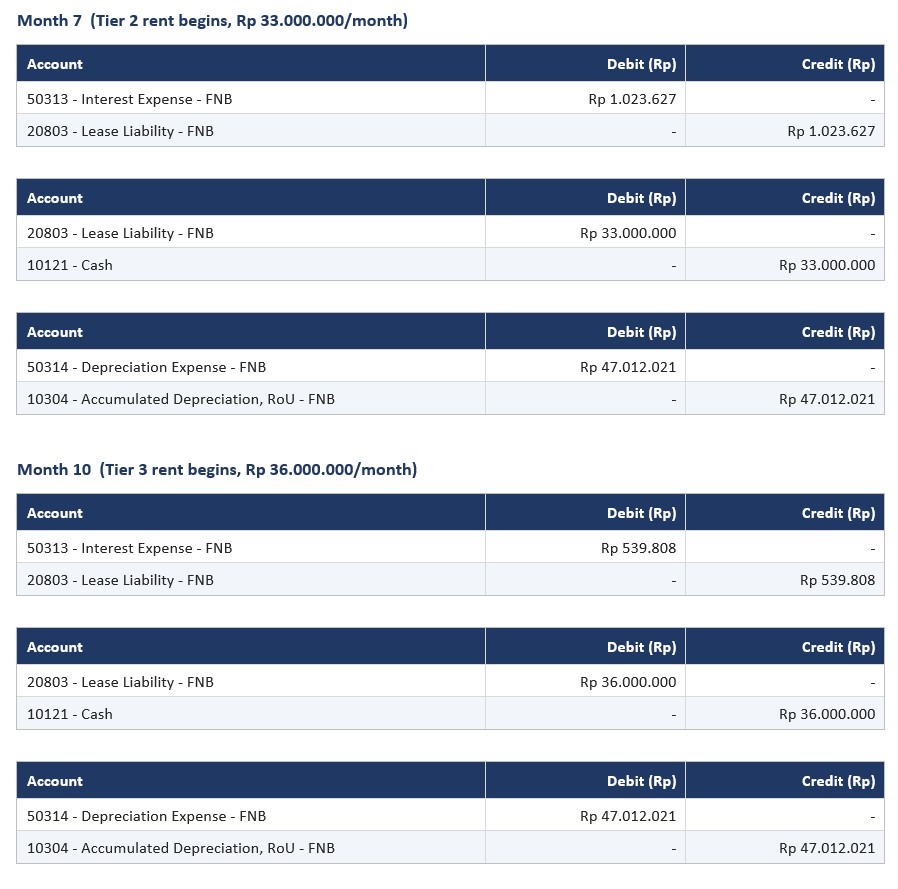
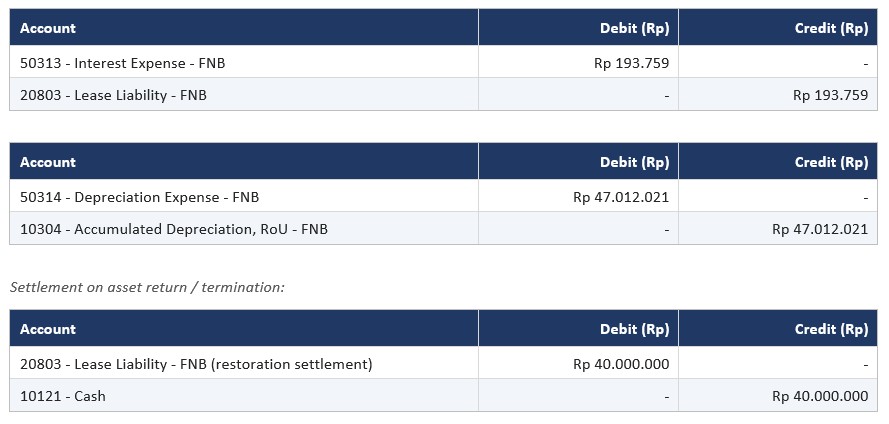
No further rent is payable in the final period; the twelve contracted payments were completed in Periods 0 through 11. Interest continues to accrete on the remaining balance, which by construction equals the undiscounted restoration contingency. Depreciation completes, bringing the RoU asset to zero. On physical return of the unit to the landlord, the restoration obligation is settled in cash.
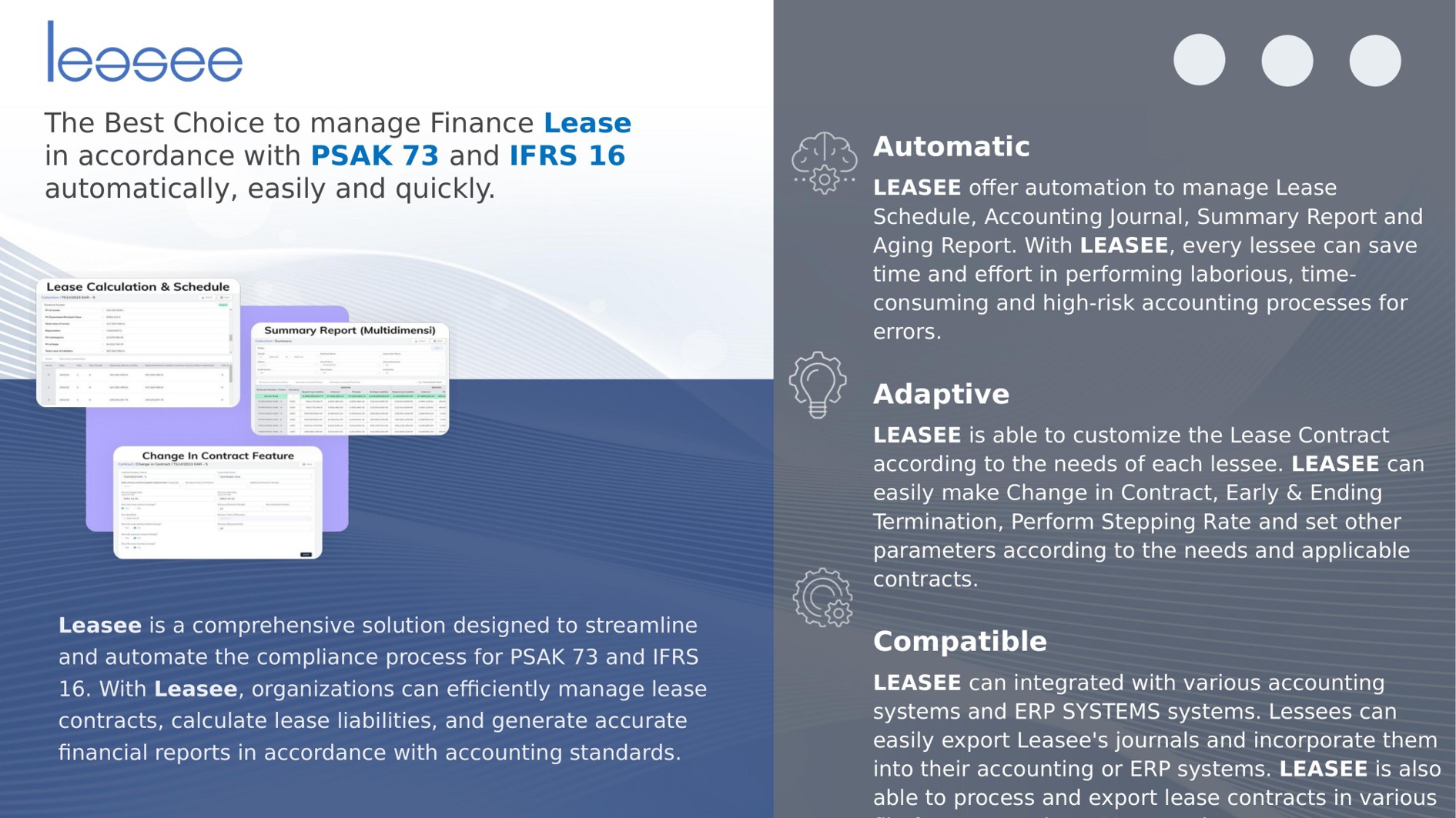
Everything computed by hand in Section 2, the stepped present-value calculation, the dual RoU/liability build-up, the 13-row amortization schedule, and every journal entry, is precisely what Leasee's calculation engine performs automatically the moment contract data is entered. The platform was built by PT Sazanka Henig Solusi specifically to remove manual spreadsheet risk from PSAK 73/116 and IFRS 16 compliance, and its architecture follows a single, auditable flow from data entry to reporting.
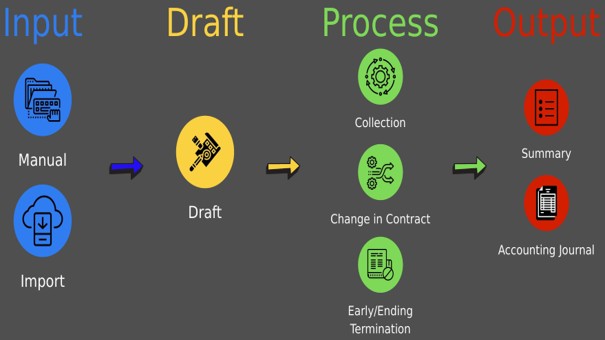
For a chain onboarding an existing portfolio, or opening several outlets in the same quarter, entering contracts one at a time is not practical. Leasee supports two input paths side by side:
• Manual entry, for one-off contracts, capturing the full set of commercial terms, cost center, profit center, business unit, lessor, discount factor and method, payment terms, capitalized cost, contingency, bargain purchase option, and residual value fields in a guided, step-by-step form.
• Batch import, for bulk onboarding through a structured CSV or XLSX template, once the entity's chart of accounts has been mapped to Leasee's Asset Class structure. This is the path a chain typically uses when migrating its entire outlet portfolio onto the platform, or when a development team signs a batch of new leases in a single period.
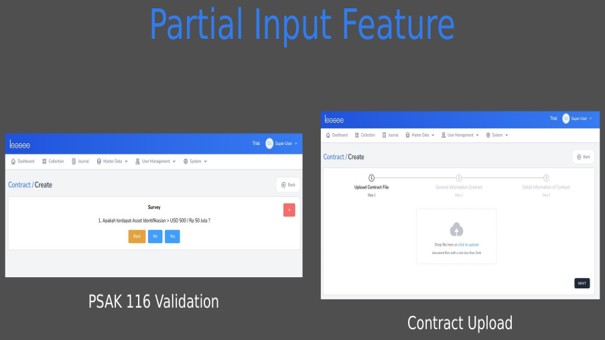
Every contract, whichever path it enters through, passes through the same validation logic before it is processed, including an identifiable-asset threshold check consistent with PSAK 116, shown below as it appears in the application, alongside the contract upload step used to attach the signed lease document itself for audit reference.
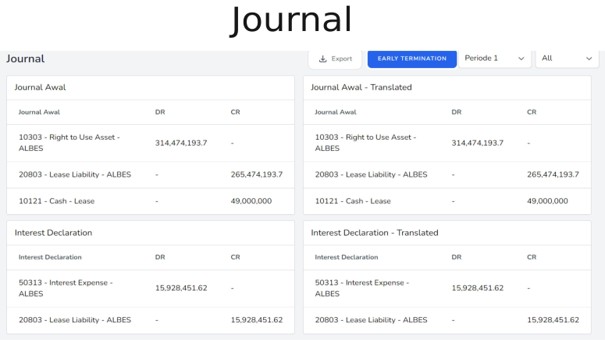
Once a contract is confirmed in Draft, Leasee's Collection engine builds the full period-by-period schedule automatically, applying whichever discount convention the entity uses, simple, compound, or a custom method, consistently across every contract in the portfolio. Stepped rent tiers, capitalized costs, and contingency provisions are handled as native fields, not manual formula overrides, and the same two integrity checks demonstrated in Section 2, the closing liability reconciling to the contingency and the closing RoU reducing to zero, run automatically on every schedule the system produces. The output feeds directly into a generated accounting journal, coded to the entity's own chart of accounts through the Asset Class mapping, as shown below for a processed contract.
Rent renegotiations, term extensions, and outlet closures are handled as first-class workflows rather than off-system adjustments:
• Change in Contract lets a user record a modification, a revised rent, an extended term, a changed discount rate, and have the liability and RoU asset remeasured and the schedule regenerated from the effective date forward, without rebuilding the contract's history.
• Early Termination captures whether a penalty applies when an outlet closes ahead of its contracted term, and adjusts the remaining liability and asset accordingly.
• Ending Termination handles the contract reaching full term, including execution of any bargain purchase option and the fair value assessment on asset return, exactly the step-12 settlement demonstrated in Section 2.
Every contract carries Business Unit, Cost Center, and Profit Center tags, which for a restaurant chain map naturally onto brand, region, and individual outlet. Summary reports (liabilities, payments, and asset values) and Aging reports (current period, year-end, and full remaining term) can be filtered and rolled up along any of those dimensions, giving a controller a single, current view across the entire outlet footprint instead of a manual roll-up of separate files. For groups operating multiple legal entities, or franchise structures with contracts denominated in more than one currency, multi-company and multi-currency handling (using period average and closing rates) are native, not a workaround.
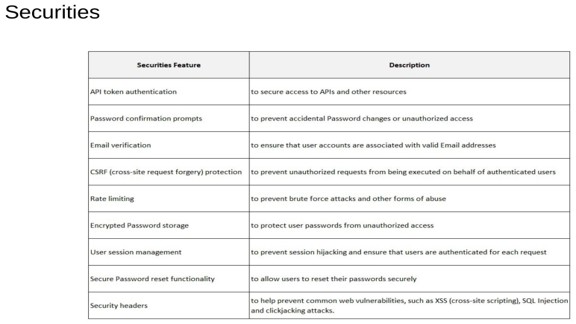
Lease data sits alongside some of the most sensitive figures in a company's financial statements: real estate commitments, off-market rent terms, and forward liabilities. Leasee's application layer is built with that sensitivity in mind:
The value of automating PSAK 73/116 and IFRS 16 compliance is easiest to see by returning to the single outlet in Section 2. That one contract required a multi-tranche present value calculation, a separately discounted contingency, a 13-row schedule, and sixteen journal-entry lines, done correctly, before it could be relied on for a single monthly close. A finance team can, and Section 2 proves it, do that once, carefully, by hand. What does not scale is doing it correctly, consistently, and auditably for every outlet, every month, as the chain grows from tens to hundreds of locations, through every rent renegotiation, relocation, and closure along the way.
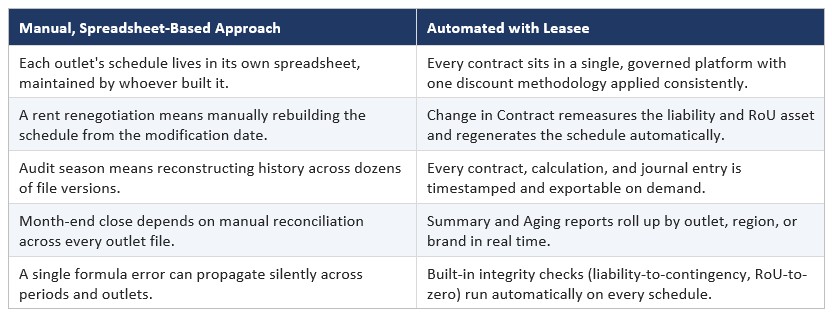
Whichever platform a chain evaluates, the questions worth asking are the same ones this article has walked through in detail:
• Can it discount a stepped, multi-tier rental structure correctly, period by period, not on an averaged basis?
• Does it separately track and accrete a restoration or reinstatement contingency to its full undiscounted value at lease end?
• Can a rent renegotiation or partial termination be remeasured without manually rebuilding the schedule?
• Does it produce an auditable, GL-coded journal your existing accounting or ERP system can actually consume?
• Can it report by outlet, region, brand, and legal entity, not just in aggregate?
PT Sazanka Henig Solusi built Leasee specifically to automate PSAK 73, PSAK 116, and IFRS 16 compliance end to end, from contract intake through journal generation and portfolio-wide reporting. To see the platform run the calculation this article walked through by hand, using your own outlet portfolio's rent structure, fit-out costs, and restoration terms, contact PT Sazanka Henig Solusi to schedule a customized demonstration.
Please contact our expert:
Hananto Pandu SE., S.Kom., Ak., CA., CPA., ASEAN CPA. - 0896 3626 1684
Best Regards,
Yohannes Ekaputra Sananto SE. MSc.
yohannes.sananto@sazankahenig.com
Financial Product Consultant
PT Sazanka Henig Solusi
Sazanka Henig Solusi is a Jakarta-based enterprise technology partner delivering simple, integrated, and intuitive solutions across Enterprise Performance Management, business intelligence, process automation, generative AI, compliance, HR technology, and cybersecurity — helping Indonesian enterprises turn complex business transformation into a lasting competitive advantage.
Are you ready to take your business to the next level? Contact us today to learn how our innovative solutions can help you achieve your goals and drive success
Get Started%202.png)