
.png)

Think about what an Indonesian CFO has had to plan around in the past twelve months alone. A Rupiah that has weakened for several consecutive years and now trades above Rp18,000 to the US Dollar. A US tariff regime that has been proposed, challenged, renegotiated, and layered with new sector-specific duties — more than once within the same year. Nickel export levies tied to a moving price band. A consumer base whose spending shifts with every swing in fuel and staple food prices. None of this is a hypothetical stress test. It is the operating environment for FMCG, manufacturing, and resource companies across the archipelago right now.
And yet most enterprises are still forecasting the way they did a decade ago: an annual budget built once, a quarterly forecast refreshed from last quarter's numbers, and a set of internal assumptions that quietly go stale the moment a tariff announcement, a currency swing, or a shipping delay makes the news. By the time the forecast reaches the boardroom, the world it was built for has already moved on.
Board Foresight — the AI forecasting engine inside Board's Enterprise Planning Platform — was built to close exactly that gap. It's the same platform that helps global brands like Kraft Heinz and Whataburger sharpen forecast accuracy and build resilience into their planning. At Sazanka Henig Solusi, we bring Board Foresight to Indonesian enterprises, paired with the local expertise to make it work inside real Indonesian finance, tax, and supply chain operations. This is our view — as a technology partner, not just a vendor — on why continuous, externally-aware forecasting is becoming the defining capability for Indonesia's next generation of CFOs, Chief Strategy Officers, Supply Chain Directors, and Operational Planners.

Most organizations, including many of Indonesia's largest enterprises, are effectively running three separate forecasts under one roof. Finance builds a macro view and an annual budget. Operations builds a demand view from historical sales. Sales or merchandising builds a pipeline or assortment plan. Each team trusts its own numbers — and each is looking at a different picture of the same business. When a shock arrives — a tariff change, a currency swing, a supplier delay — there is no single, shared forecast to update. There are three to reconcile, usually after the damage to margin or service levels is already done.
External data changes that equation. Enterprises that plan against outside market and economic signals, not just their own sales history, consistently outperform those that don't:

Benchmarks reflect outcomes documented across organizations using external-data-driven forecasting on the Board Foresight platform; individual results vary by industry, data maturity, and scope of implementation.
For an Indonesian enterprise, these are not abstract percentages. A 32% drop in stockouts is the difference between a product being on shelf in Makassar during a high-demand week and losing that sale — and that shopper — to a competitor. A 25% reduction in inventory costs is working capital released from safety stock sitting in a regional warehouse against a delay that may never happen. This is what continuous, externally-aware planning makes possible.

In short, Board Foresight is an enterprise-grade AI forecasting platform that unifies external market intelligence, econometric modeling, and operational demand forecasting inside one continuously updated planning environment. It replaces the once-a-quarter forecast with a living one, through three capabilities in particular.
Rather than forecasting purely from a company's own sales history, Board Foresight draws on a Global Intelligence Cloud of more than 5 million external datasets from over 10,000 sources, spanning roughly 168 industries and 8 macro sectors, refreshed daily. The feeds come from the kind of institutions that already anchor serious macroeconomic analysis — the IMF, the World Bank, the US Bureau of Economic Analysis, Eurostat, national statistics offices, and commodity and meteorological agencies among them.
For Indonesian planners, the practical value is direct:
- Consumer sentiment and income trends that hint at a demand shift before it appears in point-of-sale data.
- Supply chain pressure indicators that flag congestion or delay risk before a shipment is late.
- Commodity and input-cost indices — energy, raw materials, freight — that move margin long before a monthly cost report catches up.
Board calls this capability Market Signals: leading indicators that help a business spot a turning point, and the risk or opportunity behind it, while there's still time to act on it.

This is where the platform moves from informative to operational. Through Board Signals and the Tariff Dashboard — demonstrated in a live walkthrough by Board's Field CTO, Rich Wagner — planners can model the margin and landed-cost impact of a tariff change, a currency move, or a trade policy shift within the model itself, rather than waiting for the next planning cycle to catch up.
Indonesian manufacturers and exporters have lived a version of this in real time over the past year. Within the same twelve months, the effective tariff environment facing Indonesian exports to the US has been proposed at rates above 30%, renegotiated down to a reciprocal rate near 19%, and layered with duties that vary sharply by category — steel and aluminum among those facing the steepest rates, even as certain textile and apparel volumes secured more favorable terms. For a business running its landed-cost model on a quarterly cycle, each of those shifts arrives as a surprise to absorb after the fact. For a business running scenario-based forecasting — baseline, upside, and downside cases anchored to current tariff and currency assumptions rather than year-old ones — the shift is a scenario that was already on the table before the announcement broke.
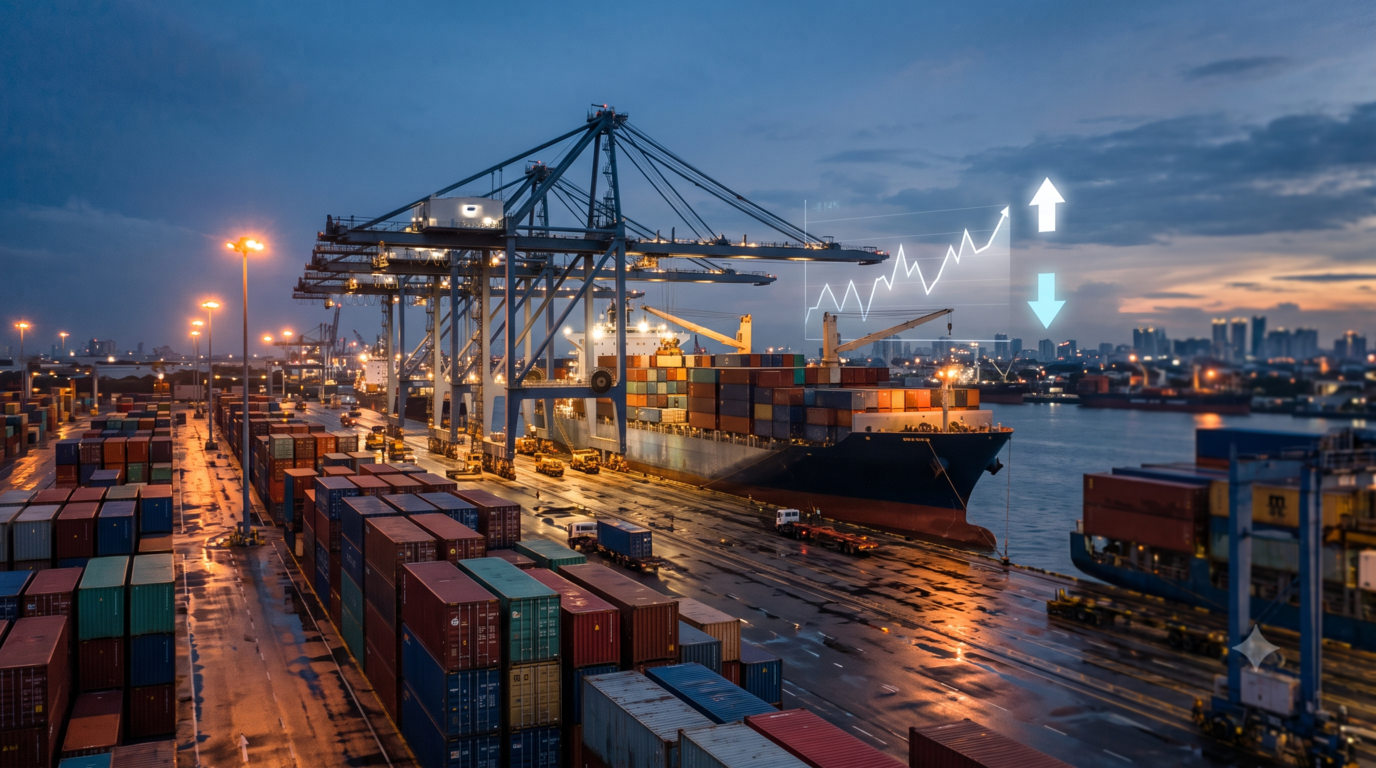
Board Foresight unifies two forecasting horizons that are normally built, owned, and argued over separately: econometric forecasting, for longer-term strategic and financial planning, and operational forecasting, at the granular demand-unit level that drives day-to-day supply chain and sales execution. When both draw on the same enterprise signal, Finance, Supply Chain, and Sales stop debating whose number is right — because there's only one number. Board calls the result decision coherence.
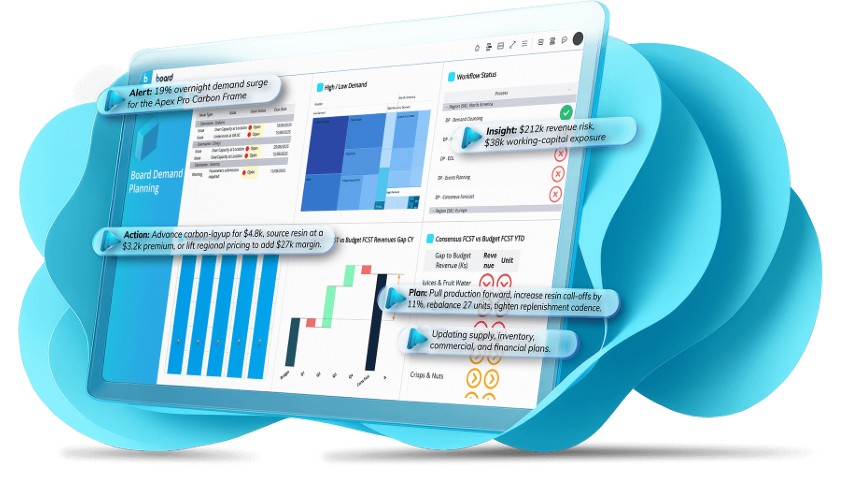
Underpinning it is agentic AI — Board Agents — that live inside the forecasting model itself rather than beside it. Instead of a planner having to notice a problem buried in a monthly report, the agent is already watching: comparing the live forecast to actual performance, running scenarios quietly in the background, and flagging a meaningful gap the moment it appears. For a CFO or Supply Chain Director, the practical effect is a forecast that updates and explains itself, instead of one that has to be manually rebuilt and re-justified at the start of every planning cycle.
The scenarios below are illustrative composites, built from the patterns we see across Indonesian FMCG, manufacturing, and resource enterprises — not an account of any single named client. They reflect the kind of outcomes Board Foresight is designed, and documented, to deliver.
Illustrative enterprise: PT Nusantara Cipta Pangan, a national packaged food and beverage company distributing across Sumatra, Java, Kalimantan, Sulawesi, and the eastern provinces.
The challenge. Distributing across an archipelago means lead times that stretch from days to weeks depending on route and vessel schedule — a single missed shipping window to an eastern-Indonesia hub can mean weeks of empty shelf space with no way to expedite. Layer on raw material inflation in packaging resin, sugar, and edible oils, plus a consumer base whose spending shifts quickly with fuel and staple food prices, and regional teams were effectively forecasting on last year's sell-in numbers and instinct about how the coming Ramadan or harvest season would compare.
The approach. Board Foresight blends external Market Signals — consumer confidence, retail sales trends, input-cost indices — with operational demand forecasting at the region-and-SKU level, so regional teams can pre-position inventory by island cluster ahead of known demand spikes. Board Agents continuously watch for early divergence between forecast and actual demand or cost, flagging it before it becomes a stockout or a margin surprise.
The outcome. Meaningfully fewer stockouts on outer-island routes, less working capital tied up in precautionary safety stock, and one forecast that finance and regional supply chain teams both plan against, instead of two.
Illustrative enterprise: PT Cipta Baja Presisi, a precision components manufacturer importing steel, aluminum, and specialty resins, and exporting finished parts to regional and US markets.
The challenge. Import tariff changes on raw material inputs, a Rupiah that has moved meaningfully against the Dollar over the past year, and shifting energy tariffs were squeezing margins that had been budgeted twelve months in advance — and were already out of date by the time they were approved.
The approach. Using the Tariff Dashboard and Board Signals, finance and procurement model the landed-cost and margin impact of specific tariff and currency scenarios by product line before committing to supplier contracts or export pricing. Scenario-based forecasting keeps procurement, pricing, and finance working from the same live assumptions, rather than three separate spreadsheets built on three separate dates.
The outcome. A reaction time between a tariff or currency announcement and an updated pricing or procurement decision measured in days, not a full quarter — and protected margin bands through a year of repeated rate changes.
Illustrative enterprise: PT Sumber Alam Raya, a diversified natural resources exporter with nickel processing operations in Sulawesi and palm oil plantations in Kalimantan.
The challenge. Capital decisions — a new processing line, a plantation replanting cycle, a port investment — are made against commodity prices, export levies, and downstream processing policy that can shift with little warning, and against weather patterns that affect both mining logistics and crop yield. Heavy customer concentration in a small number of export markets added further exposure.
The approach. Board Foresight's global datasets, including meteorological data alongside trade, commodity, and macro indicators, feed multi-year econometric scenarios for capital allocation, while continuous monitoring of export-policy and price-band signals means shifts in levy thresholds or quota changes surface as they emerge rather than after the fact. "What if" scenario models — a new buyer market, a new levy tier, a benchmark price shift — feed directly into the capital budgeting and hedging conversation.
The outcome. Capital allocation grounded in continuously updated external signals instead of a single annual commodity price assumption, earlier visibility into policy shifts affecting export economics, and one forecast connecting the mine- or plantation-level operating plan to the long-range plan the board actually approves capital against.
---
Global technology is only as valuable as the team that fits it to a specific business. That has been our role in the Indonesian market since 2016: bringing world-class technology — Board among it — and adapting it to Indonesian regulatory frameworks, tax structures, and the operational realities of doing business across the archipelago.
Simple, Integrated, Intuitive is not a tagline we apply after the fact. It's how we approach every implementation:
- Simple — a forecasting platform only Finance can operate isn't really being used. We design for the CFO, the supply chain planner, and the plant manager alike.
- Integrated — Board Foresight delivers the most value connected to the rest of the business: the ERP, the finance close, the demand planning process, not running beside them as another silo. It's also why our own portfolio extends beyond EPM into process automation (UiPath, Microsoft Power Automate), business intelligence (Dr.Sum, MotionBoard, Realtime BI), lease accounting compliance (Leasee, for PSAK 73 and IFRS 16), HR technology (GreatDay HR), generative AI (AISA), and cybersecurity — so an enterprise gets one accountable partner across its data and decision infrastructure, not a different vendor for every system.
- Intuitive — adoption, not installation, is the real measure of a successful rollout, which is why every engagement includes hands-on training for the teams who will run the platform long after go-live.
We take on the full lifecycle of a Board Foresight deployment: designing the forecasting model around a client's specific markets and products, implementing and integrating the platform into existing systems, and training internal finance, supply chain, and planning teams to run it with confidence — so continuous planning becomes a capability the organization owns, not a dependency on an outside vendor. It's also why Board itself carries a 4.4/5 rating on G2 and 4.7/5 on Gartner Peer Insights: a platform enterprise users already trust, delivered by a partner who understands what it takes to make that trust hold up inside an Indonesian operation.

The Indonesian enterprises that pull ahead over the next several years will not be the ones with the most detailed annual budget. They will be the ones that treat forecasting as a continuous, outward-looking discipline — built to update the moment the Rupiah moves, a tariff changes, or a shipping window closes, rather than waiting for the next quarterly cycle to catch up.
Board Foresight gives Indonesian CFOs, Chief Strategy Officers, Supply Chain Directors, and Operational Planners the technology to make that shift. Sazanka Henig Solusi gives them the local partner to make it real — from the first design conversation through implementation, integration, and team training.
Ready to see what continuous planning looks like for your business? Talk to Sazanka Henig Solusi about a Board Foresight readiness conversation, tailored to your industry and your data.
For further information, product demonstrations, and implementation consultation, contact our expert team:
For more information and consultation, contact our expert:
Hananto Pandu SE., S.Kom., Ak., CA., CPA., ASEAN CPA. - 0896 3626 1684
Best Regards,
Yohannes Ekaputra Sananto SE. MSc.
yohannes.sananto@sazankahenig.com
Financial Product Consultant
PT Sazanka Henig Solusi
Sazanka Henig Solusi is a Jakarta-based enterprise technology partner delivering simple, integrated, and intuitive solutions across Enterprise Performance Management, business intelligence, process automation, generative AI, compliance, HR technology, and cybersecurity — helping Indonesian enterprises turn complex business transformation into a lasting competitive advantage.
Are you ready to take your business to the next level? Contact us today to learn how our innovative solutions can help you achieve your goals and drive success
Get Started%202.png)